


AI in Commercial Real Estate

September 16, 2026
AI in Commercial Real Estate
September 16, 2026

According to Deloitte's 2026 Commercial Real Estate Outlook, surveying over 850 C-suite executives at firms managing more than $250 million in assets, 75% of global CRE leaders plan to increase investment levels over the next 12 to 18 months – yet 27% report significant challenges with AI implementation, including data quality issues and a lack of internal expertise.
This analysis draws on Smart Capital Center – a CRE AI platform that has processed $500B+ in transactions across 120M+ properties, used by JLL, KeyBank, and leading institutional lenders – to show how a modern real estate deal analyzer actually functions in practice.
The pressure to move fast is real. Capital is returning to the market, deal competition is intensifying, and teams that rely on spreadsheets and manual underwriting are losing ground to firms that can screen, score, and model a deal in the same time it used to take just to gather the documents. A capable real estate deal analyzer does more than run numbers. It changes how many deals your team can realistically pursue.
A commercial real estate deal analyzer is software that evaluates the financial viability of a CRE investment by processing property data, financial documents, and market signals to produce a structured investment assessment.
At its most basic level, it takes inputs – rent rolls, trailing 12-month financials, lease abstracts, operating expenses – and returns key metrics:
What separates a modern AI real estate deal analyzer from a traditional Excel model is the source of those inputs and the speed at which they're processed.
Manual models require an analyst to extract numbers from PDFs, reformat them, and plug them in by hand. A single financial statement can take 30 to 40 minutes to process. AI-powered platforms – like Smart Capital Center – reduce that to under 3 minutes by extracting and structuring document data automatically, validating figures against source documents, and flagging exceptions without human intervention.
The most time-intensive part of deal analysis is not financial modeling, it is preparing the data. Offering memorandums, rent rolls, and T-12s arrive in inconsistent formats, requiring manual extraction and normalization before any analysis begins. This creates a bottleneck that slows every downstream decision.
AI removes that bottleneck by extracting and structuring data automatically, allowing analysts to move directly to validation and decision-making. The result is not just faster analysis, but more consistent and auditable outputs across every deal.
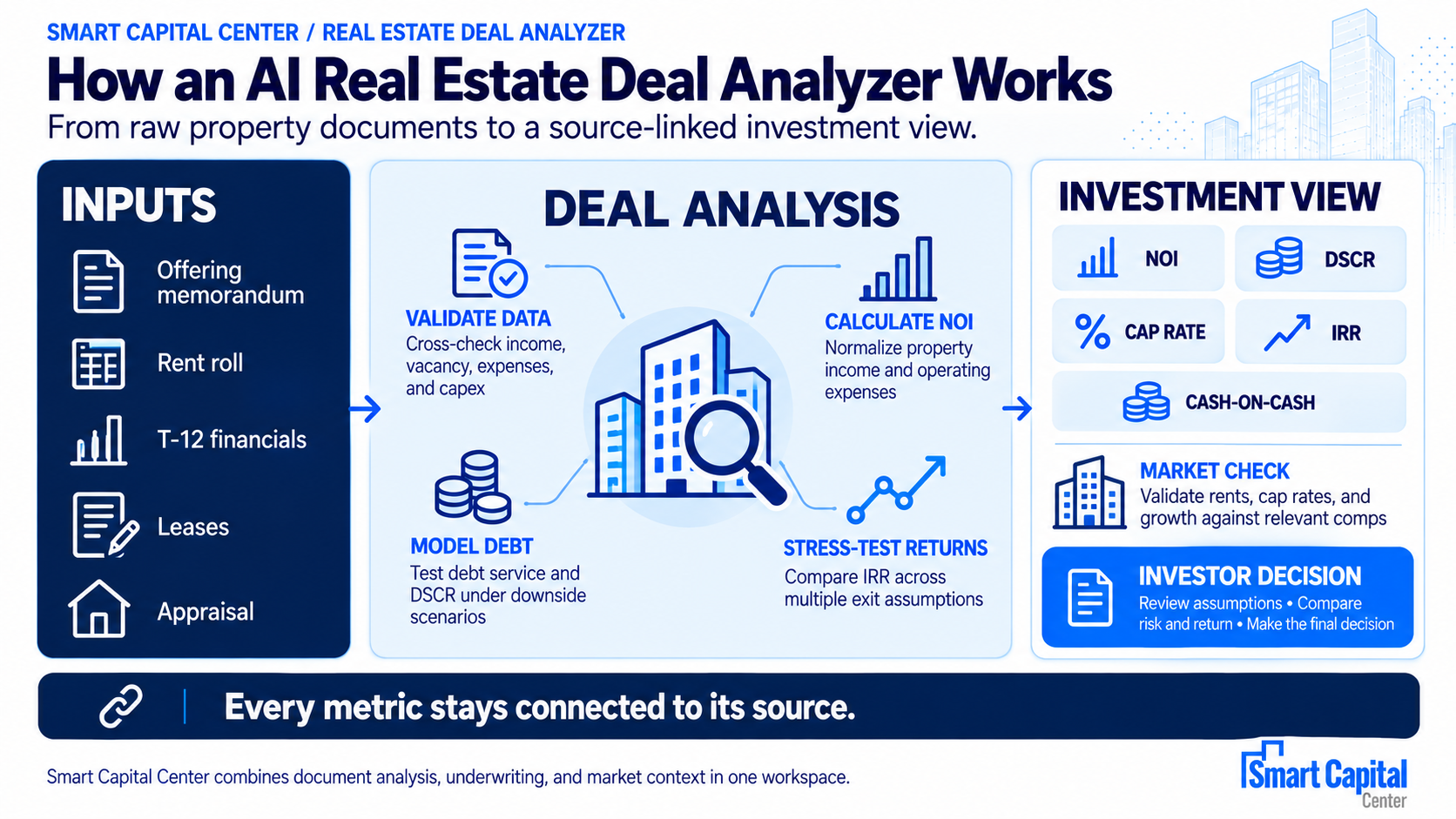
AI extraction works differently from manual review. Rather than having an analyst read and transcribe each figure, machine learning models trained on CRE-specific document libraries identify data fields by context and structure, not just position on the page. This means the system can extract occupancy, lease expiration dates, and escalation clauses from a non-standard rent roll without relying on a rigid template.
The practical result: document ingestion that used to require hours of analyst time is compressed into minutes, with every extracted figure traceable back to its source in the original document. That audit trail matters when the deal goes to an investment committee or credit committee for approval.
Smart Capital Center satisfies all six steps within a single platform, from document ingestion through comps benchmarking, with every output traceable to its source data.
Industry adoption is increasingly driven by measurable results at the institutional level.
A Director of Asset Management at JLL noted that AI-driven extraction reduced financial statement processing from 30–40 minutes to under 3 minutes, allowing teams to shift focus from manual input to higher-value analysis. Similarly, a Senior Vice President at KeyBank reported a 40% reduction in loan preparation time during implementation, with efficiency gains realized before full deployment across the organization.
AI-powered deal analysis introduces specific risks that investors and lenders should address before full deployment.
AI models trained primarily on liquid, data-rich markets can produce overconfident valuations in secondary and tertiary submarkets where comparable transaction volume is low. An AI that cites 15 comps in a primary market may have only 2 or 3 in a smaller market – and the confidence interval on the output should reflect that.
Smart Capital Center mitigates this through its proprietary data lake, which builds a benchmarking database from every document analyzed across the platform, not just publicly available data. This increases submarket coverage over time as deal volume accumulates.
Automated underwriting models can generate outputs that look authoritative but rest on assumptions the analyst never examined – particularly rent growth rates and exit cap rates that are pulled from general market data rather than asset-specific conditions. Smart Capital Center's exception management flags AI-generated assumptions that fall outside user-defined parameters, prompting analyst review before those figures flow into the final model.
When lease abstracts and rent rolls are extracted at deal screening and then updated documents arrive later in due diligence, version discrepancies can silently corrupt the underwriting model. Smart Capital Center's source-level audit trail links every extracted figure to the exact document version it came from, making version mismatches visible immediately rather than at closing.

Smart Capital Center passes all five criteria – it processes 120M+ properties with live data, provides source-level traceability on every extracted figure, covers the full CRE lifecycle from origination through asset management, and integrates natively with Yardi, SS&C Precision, and other major accounting platforms.
A modern real estate deal analyzer changes more than speed. It changes decision capacity.
AI-powered platforms allow teams to:
The result is a more scalable and reliable investment process. Instead of relying on limited deal flow and manual analysis, firms can systematically identify, evaluate, and act on opportunities with greater precision.
In a market where competition is increasing and capital is returning, the ability to evaluate more deals with better data is no longer a marginal advantage — it is a requirement for maintaining performance.
Most CRE teams are not limited by capital — they are limited by how many deals they can realistically analyze.
Smart Capital Center removes that constraint by combining AI-powered document extraction, real-time underwriting, and access to 1B+ market signals in a single platform.
See how your current workflow compares.Book a demo with Smart Capital Center and evaluate your next deal in minutes.
How can I use real estate deal analyzer software if my documents are inconsistent or non-standard?
AI platforms like Smart Capital Center identify data fields by context, not rigid template positioning, so they handle non-standard rent rolls, inconsistent financials, and varied formatting. Where confidence is low, the platform flags exceptions for analyst review rather than silently passing incorrect figures into the model.
What metrics should I prioritize when I analyze a commercial real estate deal for the first time?
Start with NOI and DSCR – these confirm whether the property covers its operating costs and debt obligations. Once validated against actual historical performance, add cap rate for pricing context and IRR for return modeling across the hold period.
How long does it take before I see time savings after deploying AI deal analysis software?
Most teams see measurable time savings within the first week, primarily on document extraction. KeyBank's senior vice president reported a 40% reduction in loan preparation time, with that result achieved mid-implementation before full deployment.
How do I know if AI-generated deal outputs are accurate enough for my investment committee?
Smart Capital Center provides a source-level audit trail on every extracted figure, so any committee member can trace a DSCR back to the exact T-12 line that produced it. JLL reported a 90%+ reduction in document processing errors after deployment – that traceability is what makes AI outputs defensible at the committee level.
How can I evaluate whether AI deal analysis software will actually integrate with my existing systems?
Ask whether the platform connects to your accounting system (Yardi, SS&C, RealPage) via direct API rather than requiring manual exports. Also confirm your existing underwriting templates can be imported – platforms that force workflow changes are the ones most commonly abandoned before full adoption.