


AI in Commercial Real Estate

September 8, 2026
AI in Commercial Real Estate
September 8, 2026

According to the CREFC 2025 Lender Sentiment Survey, fragmented borrower communication is cited by institutional CRE lenders as one of the top three operational drags on loan servicing team efficiency, with the absence of structured borrower-facing workflows creating both compliance exposure and relationship friction at critical loan events. For lenders still managing borrower communication through personal inboxes and scattered email threads, that finding reflects a gap that grows with every loan added to the portfolio.
This analysis draws on Smart Capital Center, a CRE platform processing $500B+ in transactions across 120M+ properties, used by institutional lenders and asset managers including KeyBank and JLL, to map what a modern borrower portal delivers for both lenders and the sponsors they serve.
The CRE Finance Council established the industry standard for structured borrower-servicer communication in its CMBS Borrower’s Quick Guide for Communicating with Your Servicer, which directs borrowers to communicate “according to the directions provided in the servicer’s communication, web portal, billing statements, payment advice and/or other correspondence.” That guidance, published by CREFC and used across the CMBS market, establishes the borrower portal not as an optional convenience feature but as the expected channel through which structured lender-borrower communication should flow. The compliance and documentation standard CREFC describes requires a trackable, logged system. Email threads do not meet it.
A borrower portal is a secure, structured interface that gives CRE borrowers direct access to their loan information, document exchange, request submission, and lender communication, all organized by loan rather than managed through email threads.
Without it, CRE loan communication defaults to email. And email-based loan management produces consistent failure modes that scale with portfolio size:
• Borrowers do not know their loan status without asking, creating a steady stream of routine inbound queries that consume loan servicing team time.
• Document submissions arrive in personal inboxes, get forwarded inconsistently, and are filed or not filed, depending on the individual who received them.
• Critical communications around maturity, reserve replenishment, and compliance deadlines travel through channels with no delivery confirmation and no structured follow-up.
• The “did anyone reply to this?” problem: when a borrower responds to a maturity notice, no one on the lender team has clear visibility into whether the response was received, read, or acted upon.
The stakes are highest at maturity. According to Trepp’s Q4 2024 CRE Loan Performance Report, loans where maturity communication was structured and early (initiated 90 or more days before the maturity date with a documented borrower response) showed materially better extension and refinancing outcomes than those managed reactively in the final 30 days. Communication infrastructure at the 90-day mark is part of loss mitigation.
Sophisticated sponsors are increasingly benchmarking lenders on the quality of their operational tool. The expectation is not complex: a single login that shows everything relevant, self-service access to routine information, and structured communication that does not require a phone call to resolve.
In CRE lending, that translates to four specific expectations:
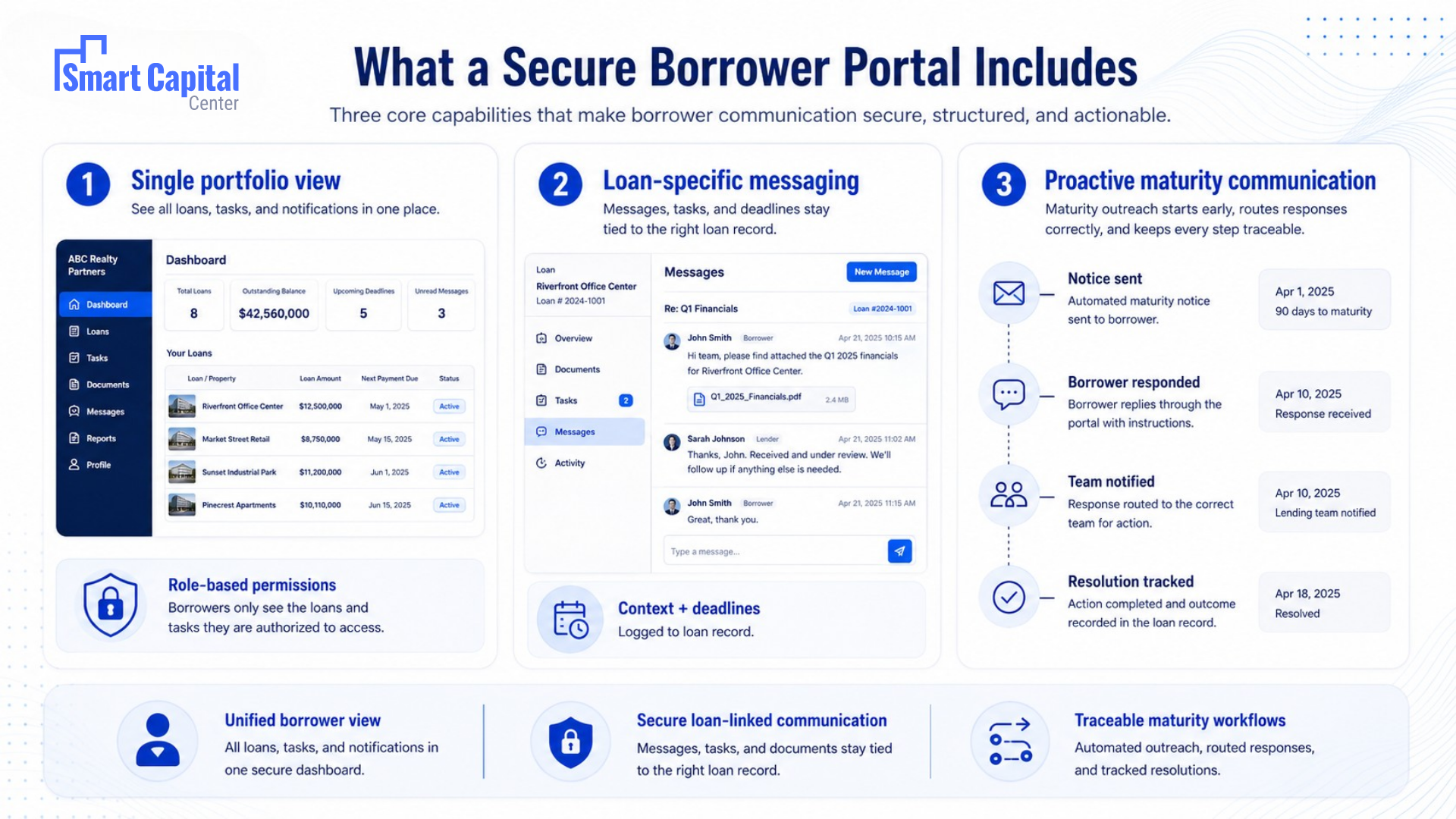
Smart Capital Center’s borrower portal opens to a configurable home view that puts action items and notifications front and center. A borrower managing eight loans across five properties sees all of them in one interface, without navigating between separate communication threads or calling the team to ask what is outstanding.
Role-based permissions ensure each borrower sees only their own loans and tasks. A borrower in a multi-sponsor relationship cannot access another sponsor’s data, and the lender controls exactly what each borrower sees and can submit.
Email-based lender-borrower communication has one structural problem no inbox management system solves: messages are not tied to the loans they concern. A maturity discussion thread, a repair authorization exchange, and a financial statement submission request all live in the same inbox alongside every other email, with no structural connection to the loan record they relate to.
Smart Capital Center’s in-portal messaging ties every communication to a specific loan or request. When a lender sends a task back to a borrower, the borrower receives it with context: why the task exists, what is required, and what the deadline is.
According to KPMG’s 2025 Generative AI in Real Estate Report, lenders that have structured their borrower-facing technology around loan-specific communication workflows, rather than general inbox management, report significantly higher borrower satisfaction scores and lower loan servicing call volumes than those managing communication through email alone. The exchange is logged against the loan record, not buried in a personal inbox.
Maturity is the highest-stakes communication moment in any loan relationship. A borrower who receives a maturity notice 30 days out and has no clear channel to respond, or whose response lands in an inbox that takes three days to action, experiences a process that signals operational weakness at exactly the wrong moment.
Smart Capital Center automates early maturity outreach and, when a borrower responds, surfaces the right next step rather than leaving the lender team to determine it from an unstructured reply. The borrower’s response is logged against the loan, the appropriate team member is notified, and the communication thread is traceable from first notice to final resolution.

The 60-to-90-day window before loan maturity is when structured communication matters most. When maturity notices go out over email and borrower responses arrive in a personal inbox, there is no guarantee the response reaches the right team member in time to action it. A borrower who replied and received no follow-up for two weeks is experiencing a lender operational failure at the highest-stakes moment in the loan relationship.
Smart Capital Center mitigates this through structured maturity communication that logs every outbound notice, routes every borrower response to the appropriate team member, and surfaces the next step automatically, so the response window does not close because the right person did not see the email.
When a compliance deadline is communicated over email, delivery confirmation depends on the email client, and response tracking depends on whoever is monitoring that inbox. At regulatory examination, demonstrating that a required communication was sent, received, and acted upon requires reconstructing a record from email archives, calendar notes, and individual recollections.
Smart Capital Center mitigates this through a full communication audit trail that logs every outbound notification, every borrower response, and every team action against the relevant loan record: automatically, continuously, and in an exportable format. The compliance record exists without anyone needing to create it.
The lenders building the strongest borrower relationships are those whose infrastructure makes the borrower experience structured, transparent, and consistent across every loan in the portfolio.
Smart Capital Center’s secure borrower portal gives borrowers a single view of all loans, action items, and notification history, while giving lenders a complete, searchable audit trail of every communication tied to every loan. The question “did anyone reply to this?” does not arise in a system where every reply is automatically logged, routed, and visible to the full team.
Give your borrowers a single login for everything and give your team a complete communication record for every loan. Book a demo with Smart Capital Center.
A borrower portal is a secure, structured digital interface that gives CRE borrowers direct access to their loan information, document exchange, request submission, and lender communication, all organized by loan rather than managed through email threads. For lenders, it replaces the fragmented, inbox-driven communication model with a structured system where every interaction is logged, routed, and traceable. For borrowers, it replaces the need to contact the loan servicing team for routine information with on-demand self-service access to statements, schedules, and action items.
The operational benefit is threefold. First, routine borrower queries are self-served through the portal rather than handled by the loan servicing team, reducing inbound contact volume materially. Second, document submissions and borrower requests are routed automatically to the correct team member, with a logged receipt and status trail that replaces manual inbox monitoring. Third, all communication is tied to specific loans and exportable on demand, producing a compliance record that email-based workflows cannot replicate consistently.
At minimum: role-based access controls that enforce loan-level data separation between borrowers, in-portal messaging tied to specific loans rather than general inbox threads, document upload and submission with auto-routing and logged receipt, configurable notifications with consolidated delivery for multi-property borrowers, and a full audit trail exportable for regulatory review. The security baseline for institutional use requires encrypted document transmission, access logging per session, and permission structures that prevent borrowers from accessing other sponsors’ data.
Email-based maturity communication has two failure points: delivery is unconfirmed, and response routing depends on whoever monitors the inbox that day. A structured portal handles both. Smart Capital Center automates early maturity outreach, logs delivery, and when the borrower responds, routes the reply to the appropriate team member and surfaces the next required action. According to Trepp’s Q4 2024 CRE Loan Performance Report, loans with structured, early maturity communication showed materially better extension and refinancing outcomes than those managed reactively in the final 30 days, making the portal’s maturity workflow a loss mitigation tool as much as a communication one.
Watcher subscriptions allow team members to follow specific loans or communication threads and receive notifications when activity occurs: a borrower responds, a document is submitted, a task status changes. For compliance oversight teams and senior lenders who need visibility into critical borrower interactions without being the primary point of contact, this provides transparency without copying everyone on every email. Smart Capital Center’s notification system supports this at the task, loan, and portfolio level, with configurable delivery preferences per team member.