


CRE Lenders

October 20, 2026
CRE Lenders
October 20, 2026

Construction lending is busy again. Smart Capital Center helps construction lenders turn draw management from a slow, manual process into a faster, more controlled workflow. The platform reads draw packages, reconciles invoices against project budgets, flags missing documents or duplicate charges, and gives teams a real-time view of each loan before funds are released.
That speed matters. When draw reviews take weeks, borrowers struggle to pay subcontractors, construction can stall, and lender relationships suffer. Faster funding is no longer just an operational advantage; it directly affects borrower retention and competitiveness.
The need is growing as construction lending activity increases. According to the Mortgage Bankers Association's 2026 CREF Forecast (February 2026), total commercial mortgage originations are projected to rise to $805.5 billion in 2026, up from $633.7 billion in 2025. As MBA Associate Vice President of Commercial/Multifamily Research Reggie Booker put it, commercial and multifamily borrowing “has now increased for five straight quarters.” More loans means more draws to fund. On a construction loan, how fast you fund those draws shapes the whole borrower relationship.
This guide explains how construction loan draw management works, why draws get delayed, and how Smart Capital Center helps lenders fund faster without sacrificing control or increasing risk.
Construction loan draw management is the process lenders use to release loan funds in stages as a building is constructed. Instead of handing over the full loan at closing, the lender pays out money in portions, called draws, as work is completed and verified.
Each draw is tied to a draw schedule. The draw schedule is the plan that sets how much money is released at each stage of construction. A typical project funds the foundation first, then framing, then mechanical systems, and so on.
Good draw management protects everyone. The borrower gets funds to keep building. The lender confirms the money matches real progress on the ground. Done well, it keeps the project on time and the loan in good standing. For a wider view of loan structures, see our guide to CRE loans explained.
A construction loan draw works as a request-and-release cycle. The borrower asks for money, the lender checks the request, and funds are released once everything lines up. Most loans go through 5 to 10 draws, though large builds can have more.
Here is the basic cycle:
The draw package is the heart of the process. It usually includes contractor invoices, signed lien waivers (proof that subcontractors and suppliers were paid), an updated budget accounting for retainage, and an inspection or progress report. Missing or messy documents are the number one reason draws get stuck.
Construction lending is active, costs are volatile, and projects rarely run exactly to plan. The figures below explain why draw discipline matters more than ever in 2026.
Two takeaways stand out for lenders. First, with the availability and cost of capital ranked among the top concerns in Deloitte's 2026 Commercial Real Estate Outlook, a survey of more than 850 industry executives, idle capital is expensive and execution speed matters. Second, because large projects so often run over budget and behind schedule, every draw is a control point, not a formality.
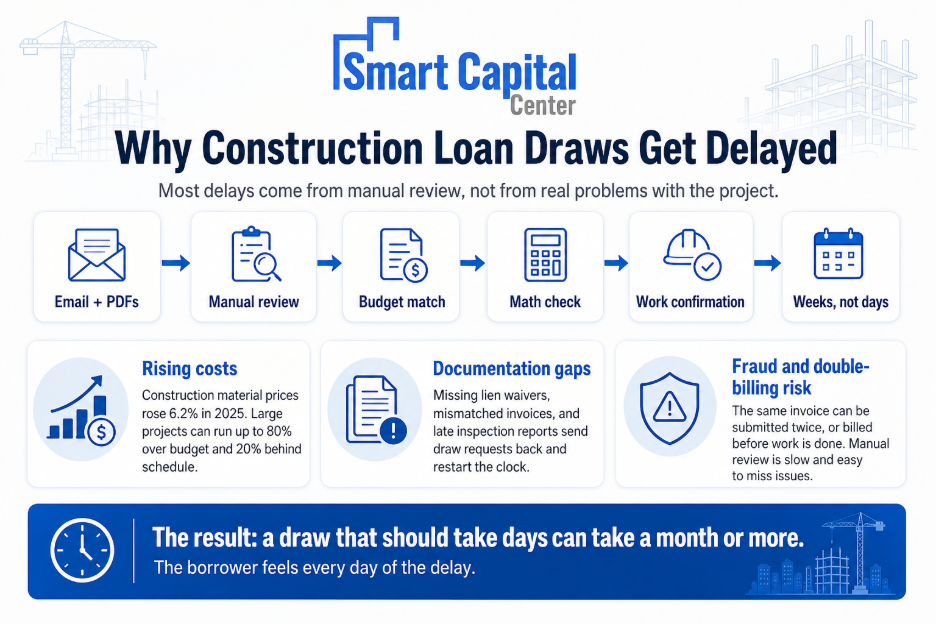
Most draw delays come from manual work, not from real problems with the project. Documents arrive by email and PDF. Someone has to read each one, match it to the budget, check the math, and confirm the work. When that is done by hand, a single draw can take weeks.
Three things make it harder right now:
Rising costs. Construction material prices rose 6.2% in 2025, the largest single-year increase since 2021, according to the U.S. Bureau of Labor Statistics Producer Price Index. When costs move mid-project, budgets shift, and every draw needs a closer look. McKinsey & Company has found that large construction projects typically run up to 80% over budget and take 20% longer than scheduled, so careful budget reconciliation on each draw is essential.
Documentation gaps. A lien waiver is missing. An invoice does not match the budget line. The inspection report is late. Each gap sends the draw back to the borrower and restarts the clock.
Fraud and double-billing risk. The same invoice can be submitted twice. A cost can be billed before the work is done. Catching this by hand is slow and easy to miss.
The result is a draw that should take days but takes a month or more. And the borrower feels every day of it.
Slow draws cost lenders more than time. They cost relationships and repeat business. A builder who cannot pay crews on time will remember which lender held up the money, and will take the next deal elsewhere.
There are direct risks too:
This is why draw speed is no longer a back-office detail. It is part of how lenders win and keep good borrowers.
Lenders can fund draws faster without cutting corners. The key is to remove manual steps and check everything against live data. Follow these five steps.
This is the work Smart Capital Center automates. The platform reconciles draw requests, invoices, and documents with AI, flags duplicate charges, and monitors budgets in real time, so approvals move faster and every dollar matches real progress. Lenders using Smart Capital Center have cut deal-level review time from two to four hours to under 15 minutes. It draws on a database of 120M+ properties and 1B+ real-time data points, which means each request is checked against deep property and market context, not just the file in front of you. Covenant tracking and loan-health alerts run alongside the draw process, giving lenders one live view of the loan. Learn more in our guide to AI CRE debt management.
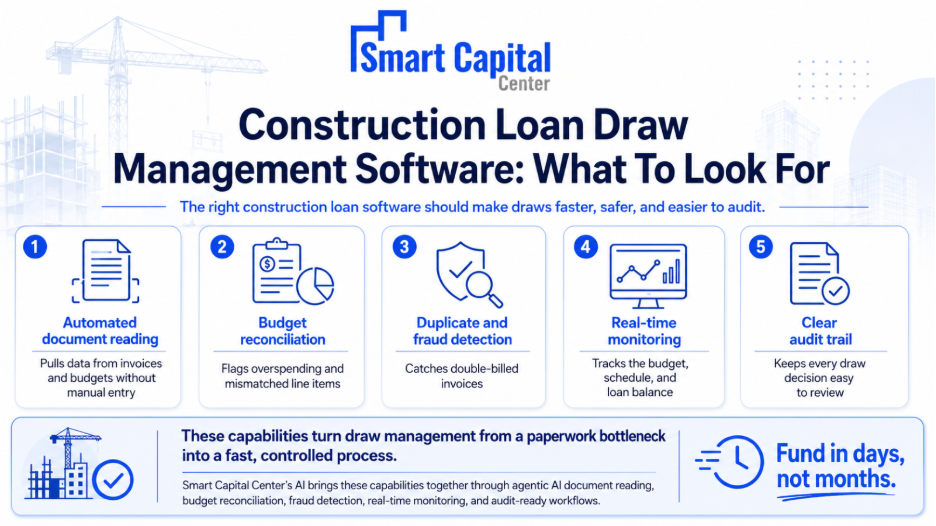
The right construction loan software should make draws faster, safer, and easier to audit. When comparing tools, look for a few core features:
These features turn draw management from a paperwork bottleneck into a fast, controlled process. Smart Capital Center’s AI brings these capabilities together through agentic AI document reading, budget reconciliation, fraud detection, real-time monitoring, and audit-ready workflows. That is the difference between a lender who funds in days and one who funds in months.

As construction lenders made clear at the BAMA Financing Event, construction loan draw management is now a competitive advantage. Lending volume is rising, costs are moving, and borrowers reward the lenders who fund draws quickly and reliably. The lenders who win will be the ones who replace manual review with real-time, data-backed automation.
Smart Capital Center gives lenders that speed. The platform automates draw reconciliation, flags risk, and monitors every loan in real time, so teams fund faster, protect their collateral, and keep their best borrowers.
Fund construction draws faster and with more control. Book a Smart Capital Center demo today.
Q: How do construction loan draws work?
A: Construction loan draws release loan funds in stages as a building is completed, instead of all at once at closing. The borrower requests funds, submits documents such as invoices and lien waivers, an inspector confirms the work, and the lender releases the draw. Most construction loans have between 5 and 10 draws, set by a draw schedule.
Q: What documents are required in a construction loan draw package?
A: A construction loan draw package usually includes contractor invoices, signed lien waivers, an updated project budget showing costs to date, and an inspection or progress report. Some lenders also require updated title information. Missing or mismatched documents are the most common cause of draw delays, which is why Smart Capital Center’s AI reads and reconciles these documents automatically and flags gaps or duplicate charges before they hold up funding.
Q: How many draws are in a construction loan?
A: Most construction loans have 5 to 10 draws, set by a draw schedule agreed at closing. Larger or longer projects can have more. Each draw is tied to a stage of construction, such as foundation, framing, or final completion.
Q: How do lenders set up a construction loan draw schedule?
A: Lenders set up a construction loan draw schedule by dividing the total loan into stages that match the construction timeline, then assigning a funding amount to each stage. Funds are released as each stage is verified as complete. Smart Capital Center’s AI tracks each draw against the schedule and budget in real time, so lenders can see immediately whether funding still matches actual progress.
Q: What is construction loan monitoring?
A: Construction loan monitoring is the ongoing process of tracking a construction loan's budget, draw schedule, and remaining balance while the project is being built. It helps lenders catch overspending, delays, and risk early. Smart Capital Center provides real-time construction loan monitoring across the full loan, with alerts when a budget, covenant, or timeline starts to drift.
Q: How does Smart Capital Center help with construction loan draw management?
A: Smart Capital Center reconciles draw requests, invoices, and documents with AI, flags duplicate charges, and monitors project budgets in real time. It checks each request against a database of 120M+ properties and 1B+ real-time data points, and runs covenant tracking and loan-health alerts alongside the draw process. This helps lenders fund draws faster while protecting their collateral.
See how Smart Capital Center automates draw reconciliation, risk flagging, and real-time loan monitoring. Book a demo today.