

CRE Investors

November 19, 2026
CRE Investors
November 19, 2026

Investors weighing an adaptive reuse project face a question that goes beyond whether a building can be converted. They need to know whether the conversion will earn more than buying a stabilized property, once construction costs, land prices, approvals, and carrying costs are all in the model. Many conversion pro formas hold up until the cost line is tested, and by then a team has often spent weeks on a deal that never clears. This article covers how experienced investors, developers, and lenders answer that question, from the yield on cost test and the contingencies they build in to the building types they say convert well and the financing structures that keep an owner’s own equity low.
The material comes from a panel at the IMN Real Estate Private Funds Summer conference in Newport, Rhode Island, held June 24 to 26, 2026. The session, titled “Buy vs. develop vs. redevelop: the 2026 opportunity matrix,” ran on June 25 and included Jay Fischer of CIM Group, Raphael Sidelsky of JVP Management, Carol Jiang of BGO Strategic Capital Partners, Briana Hildt of Cardinal Capital Group, and Tom Clayton of Touchdown Realty Group. Their answers are the substance of what follows.
Smart Capital Center’s AI agents help investment teams run this comparison before capital goes in. A team brings its own development budget and conversion assumptions, and the agents pull market comparables from 1B+ live market data points across 120M+ properties, build the projected cash flows, and set the conversion beside the stabilized building the team could buy instead. A later section covers how the comparison works in practice.

Jay Fischer, Managing Director of Investments at CIM Group, named the comparison at the start of his answer. His team looks at the cap rate on an existing building, which is the income yield an investor earns at today’s price, and sets it against the return on cost of a development. He described the return on cost with income as the numerator and cost plus land value as the denominator, using the untrended version, meaning today’s rents and today’s costs with no growth projected.
Untrended Yield on Cost = Stabilized Net Operating Income ÷ All-In Cost
All-in cost covers the purchase price or land value, hard and soft construction costs, the contingency, and the interest reserve. The spread between that yield and the cap rate on a stabilized building is what pays an investor for taking on construction and lease-up risk. Fischer’s conclusion was direct. In his words, “if that yield isn’t comparable or favorable compared to the risk return on an existing deal, math points to buying and holding an existing deal.” Carol Jiang, Principal at BGO Strategic Capital Partners, framed the same point as a question about risk: “at the end of the day it is a mathematical question buy versus develop,” and it comes down to “what kind of risk are investors being paid to take.”
An illustrative comparison shows how the test works. The figures below are an example for explanation and were not given by the panel.
In this example the conversion earns 100 basis points more than the stabilized purchase, and that spread is the payment for building, leasing, and waiting. A conversion that stabilized at a 5.50 percent yield on cost would earn what the stabilized building earns and carry far more risk.
Raphael Sidelsky, Director of Equity Strategies at JVP Management, said the spread an investor needs depends on the kind of deal. His firm has been more active in what he called higher-octane return deals such as luxury condominiums in New York and Miami, “where the profit margins are so healthy that you can afford a little bit of noise in the cost.” For regular multifamily development, he said a project needs an untrended yield on cost close to the range of 6.25 to 6.75 percent to clear the bar.
Fischer explained why the test has been hard to pass. He said construction costs have gone up 40 to 50 percent in aggregate, while land prices have not fallen much, because many owners carry no debt on the land and are content to hold it. As a result, “the math in a lot of cases outside of a structured entry into a deal or where you’re reducing the basis haven’t really allowed development to pencil in a lot of markets.” A deal pencils when the numbers work.
He pointed to two openings. A seller who is forced to sell can subordinate the basis, which changes the entry price. The second sits between sponsors and capital. Fischer said “there’s definitely a gap in the development world today between the sponsors and capital sources,” with capital sources wanting everything “completely with a bow, buttoned up and ready to go.” Many developers hold interesting sites without the balance sheet or expertise to carry them, and investors who can underwrite that risk find room to play.
Panelists on the equity side and the lending side described the same small set of controls. A contingency is a budget cushion for cost overruns, and an interest reserve is loan money set aside to pay interest while the building is under construction. A guaranteed maximum price contract, called a GMP, caps what a contractor can charge.
Hildt put the contingency rule plainly: “we always look for at least a 10% contingency in their budgets.” Clayton, a Rhode Island developer who converts existing buildings, said “typically about a 10% contingency is what I factor just on the construction side.”
Tenants in place add a second layer of risk. Clayton said “most cases I’m buying either vacant buildings or I’m buying dirt,” and wants to bring in his own tenants so the rent profile and retention match his finish level. Hildt agreed from the lender’s side. She has seen deals held up for years because the last few tenants could not be moved out, and said “the juice has to be worth the squeeze.” Her firm works in states that are very tenant friendly, which makes a partly occupied building harder to clear.
Jiang said conversions and ground-up projects sit in the same risk bucket for an allocator. In her words, “adaptive reuse projects and the development projects kind of sit in the same risk bucket because there’s a lack of cash flow,” since the work has to be finished before the building can be leased and sold. She also separated an owner whose obsolete office building has lost value from a buyer who plans a conversion from the start. The first owner risks “trying to fit it into a box that doesn’t fit.”
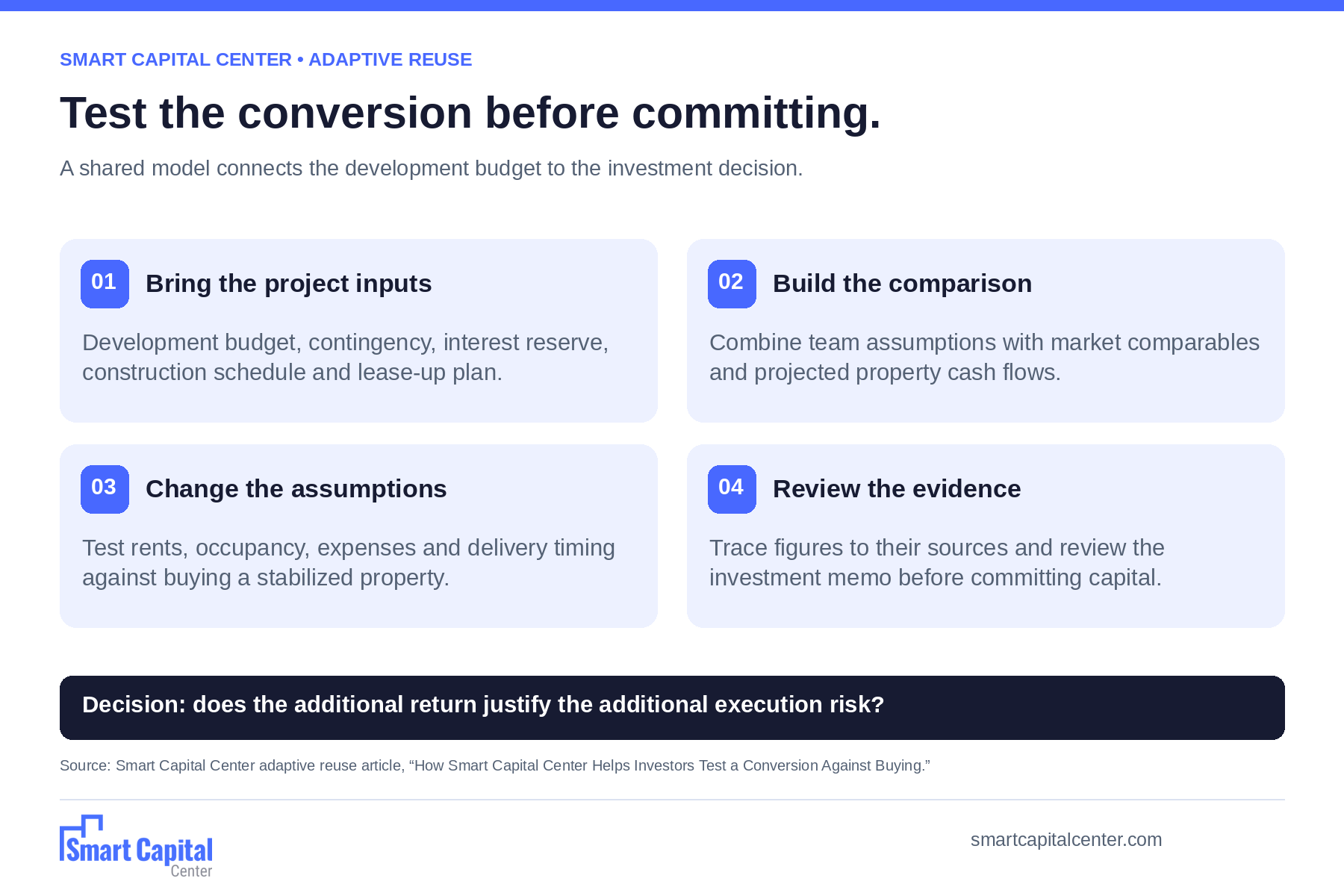
Smart Capital Center gives an investment team a way to put the panel’s test into a model before capital goes in. The team uploads its development budget, including the contingency and interest reserve lines it has chosen, along with its construction and lease-up timeline and any tax abatement. The budget comes from the team’s own contractor bids and development advisers, and the platform carries it through the analysis. Smart Capital Center’s AI agents then pull rent and sales comparables for the submarket, build the projected cash flows and a discounted cash flow (DCF) model, and set the conversion beside the stabilized building the team could buy instead.
Scenario modeling lets the team change rent growth, occupancy, expense, and timeline assumptions and see the effect on net operating income and returns right away. When Sidelsky’s range or Clayton’s 70 to 75 percent screen is the standard, the team sees which side of the line a deal falls on in minutes instead of days. Every figure links back to its source, and draft investment memos pull directly from the underwriting, so the committee reads the numbers the analyst built. Centers Dynamic Partners underwrites deals 4x faster. The work runs inside the systems your team already uses.
Teams can review the underwriting platform and the investor solutions page, and a related takeaway on conversions is in Smart Capital Center’s Multifamily Summit recap.

Buildings with residential-scale footprints, parking, and a neighborhood setting came up far more often than office towers.
Parking was the detail Clayton said people tend not to think about. A downtown office building often has none, he said, which turns away a good portion of the tenant base. His summary of the whole panel came down to location. In his words, “I think ultimately the takeaway from the panel here is location.”
Jiang added that location has to be paired with a story that makes sense. Her firm is converting hotels in Spain to flex living, because multifamily rent regulation there limits rent increases and flex living produces longer stays. “I think the story has to make sense,” she said. She also said supply-constrained markets make conversions more attractive: “Supply constraint markets like the Northeast that we all talk a lot about certainly makes more sense for conversions,” and “it wouldn’t make sense to convert something in Texas.”
Clayton described the rule he uses to decide whether a deal moves forward. He tries to figure out “how I can acquire this dirt or this building, how I can construct it, how I can work in my contingencies as well as my interest reserve, all within, say, 70 to 75% of that end value.” His goal is a refinance that returns every dollar he put in. He said he is “not looking to chase on an IRR at all,” and is “looking to extract out completely and hold this asset indefinitely and allow it to cash flow.”
He then walked through a deal he was working on. The building is a nursing home of about 35,000 square feet, which he described as a fairly hollow shell with no infrastructure. He is buying it for $2 million and expects a build-out of roughly $7 million for 62 units. On a build-out that size, he said, a 10 percent contingency would be about $700,000, and he rounds it up to about $1 million for a cushion. Adding interest, he put his all-in cost near $12 million, against an expected appraised value of $20 million to $22 million.
The arithmetic below uses the figures Clayton gave. The percentages are calculated for this article.
Even at the low end of the projected value, the deal sits well inside his screen. He said he has included “all of the potential hiccups” and all of his costs, so the deal holds up outside of whatever is said about tariffs and interest rates.
The building also carries asbestos, which Clayton treats as a pricing issue. Contamination or required remediation is typically a deal breaker for him, and when a building needs abatement, “I need to be able to get a deeper discount.” He said that is why this building is priced at $2 million against an initial listing near $4 million.
The panel described three structures, each aimed at keeping the investor’s own cash low or buying in after the early risk has been absorbed.
Staged Capital That Builds Equity Before Vertical Construction
Clayton described a process he said is probably the most obscure on the panel. A private partner commits 100 percent of the cost of acquisition, soft costs, and the horizontal work, such as underground utilities and the slab, before vertical construction starts. That work creates what he called sweat equity, and a construction lender then takes out the first partner. As a result, he said, he can “put minimal capital of my own into any of these deals.” Hildt, who lends in this market, called the arrangement “really rare and unique because most people don’t have a relationship like that.”
Bridge Loans Against Entitlement Gains
Hildt described a more common route. Her firm typically sees 10 to 25 percent down, depending on the project. In one pattern, a developer buys a small building that can be entitled for many more units, such as a two-unit building that can become ten. Cardinal finances the purchase with a bridge loan, the entitlement raises the value, and the firm then underwrites the higher value. Her example was a $2 million purchase with 10 to 15 percent down that is worth about $3 million six months later, so the developer does not put 30 percent into the whole project.
Stepping In After a Sponsor Over-Allocates
Jiang described the secondary investor’s view. BGO looks for projects where value has already been created, so it can enter at a discounted basis with a shorter path to cash flow. In one case, a sponsor expected to raise $500 million, ended with a fund of $300 million, and had over-allocated to one development, so BGO stepped in at the sponsor’s cost basis. She also described a recent conversion deal entered four years after the original purchase, once entitlement, design, and GMP financing were done, with 15 to 17 months from closing to first unit delivery.
Clayton said approvals have changed his timeline. A church conversion took him over two years and several hundred thousand dollars to get approved, while a later nursing home conversion met no comparable red tape and moved straight into permits. Rhode Island’s adaptive reuse provision, R.I. Gen. Laws § 45-24-37, took effect in 2024 and makes conversion of commercial buildings, including offices, schools, religious facilities, medical buildings, mills, and malls, a permitted use when at least 50 percent of the existing gross floor area becomes residential. The statute also caps local parking requirements at one off-street space for the first two bedrooms of each unit and keeps existing setbacks in place.
Tax incentives carry the same weight in New York City. Sidelsky said a New York conversion he is reviewing qualifies for the 467-m tax exemption, which he called very helpful. According to the New York City Comptroller’s analysis, 467-m exempts qualifying conversions from property tax for up to three years during construction and for 25 to 35 years afterward, depending on the building permit date, and requires at least 25 percent of units to be income-restricted. The program also excludes hotels.
Sidelsky also flagged rent regulation in northeastern states as a concern for owning and operating multifamily, which bears directly on the income side of the yield on cost test.
Five steps follow from what the panel described.
The panel treated adaptive reuse as a numbers question first. A conversion earns its place only when its untrended yield on cost clears the cap rate on a stabilized building by enough to pay for construction, lease-up, and approval risk, and the panelists checked that math before they looked at anything else.
That discipline matters now because construction costs have risen while land prices have held, so fewer ground-up deals pencil in many markets. The investors who do convert keep contingency in the budget, choose buildings with workable footprints and parking, confirm zoning and incentives early, and structure capital so their own equity stays low.
Analyze conversions faster. See how Smart Capital Center helps your team compare a conversion against buying a stabilized building, with every figure linked to its source. Book a demo today.
Q: How do you calculate yield on cost for a real estate development?
A: Yield on cost equals stabilized net operating income divided by all-in cost, which includes the purchase price or land value, construction costs, contingency, and the interest reserve. Jay Fischer of CIM Group described it at the 2026 IMN private funds conference with income as the numerator and cost plus land value as the denominator. Smart Capital Center builds the projected cash flows from the team’s own development budget and sets the result against the cap rate on stabilized comparables.
Q: What is a good yield on cost for a multifamily development?
A: It depends on the market and the deal, but the panelists treated the cap rate on an existing building as the starting point. Raphael Sidelsky of JVP Management said regular multifamily development needs an untrended yield on cost close to 6.25 to 6.75 percent. Smart Capital Center lets a team set its own target in the model and see which deals clear it.
Q: Is my building viable for adaptive reuse?
A: Viability usually comes down to location, parking, footprint, window placement, vacancy, and environmental condition. Tom Clayton of Touchdown Realty Group said nursing homes, schools, and some hotels have worked for him, while downtown offices often fail on parking and building core. Smart Capital Center pulls market comparables and rent data for the submarket, so a team can test whether the converted units would lease at the rents the pro forma assumes.
Q: How much contingency should a conversion budget carry?
A: A lender and a developer on the panel each used about 10 percent or more on the construction side, and Jay Fischer said older buildings also need a design contingency. A higher contingency lowers yield on cost, so the number has to be tested in the model. Smart Capital Center carries the team’s budget lines through the cash flow analysis, so the effect of a larger contingency shows up in returns right away.
Q: How do you build a pro forma for an adaptive reuse project?
A: The pro forma starts with all-in cost and the months to first unit delivery, then adds lease-up, stabilized net operating income, and any tax exemption, and compares the result with buying a stabilized building. Carol Jiang of BGO Strategic Capital Partners described 15 to 17 months from closing to first unit delivery on a conversion that was already entitled. Smart Capital Center structures inputs such as tax abatements, cap rates, and construction timelines into projected cash flows and a discounted cash flow model.
Q: How does Smart Capital Center help with adaptive reuse underwriting?
A: Smart Capital Center’s AI agents take a team’s development budget and conversion assumptions, pull market comparables, build the projected cash flows, and compare the conversion with a stabilized purchase. Every figure links back to its source document or data point, and draft investment memos pull from the same underwriting. See how it works on a live deal.