


AI in Commercial Real Estate

October 1, 2026
AI in Commercial Real Estate
October 1, 2026
.jpg)
Building an artificial intelligence (AI) agent for commercial real estate (CRE) has collapsed into a weekend project. Building the platform around it — the data foundation, integrations, security, monitoring, iteration, and the operational overhead — takes 18 to 24 months and a full engineering team. According to MIT NANDA's 2025 GenAI Divide report, 95% of enterprise generative AI (GenAI) pilots fail to deliver measurable profit and loss (P&L) impact, and Gartner reported that by the end of 2025, at least 50% of generative AI projects had been abandoned after proof of concept due to poor data quality, inadequate risk controls, escalating costs, or unclear business value. The failure point was almost never the agent. It was one of six layers underneath.
The Weekend Agent and the 18-Month Platform
According to the 2025 GenAI Divide report, 95% of enterprise GenAI pilots deliver no measurable business impact, and only 5% reach production. The model is rarely the failure point. The platform around the model is. For CRE operators evaluating whether to build their own AI tools or buy one, that 95% number is the single most important data point in the room.
Building an AI agent for CRE has become a weekend project. A managing principal can wire a foundation model into a shared drive of rent rolls on Saturday and demo it to partners on Monday. Wiring that same agent into a live property management, accounting, and valuation modeling stack, with the data quality, integrations, security, monitoring, and iteration that production demands, is an 18-to-24-month project. Six distinct layers separate one from the other. Each one is where the in-house build estimate breaks.
Smart Capital Center, the AI-powered CRE platform analyzing $500B+ in transactions across 120M+ properties, operates on the production side of that line. This article frames the build-vs-buy decision through the six layers operators discover only after the demo.
The Basics: An AI Agent Is Not a CRE Platform
An AI agent is a single-task completion engine — it reads a rent roll, drafts a memo, summarizes a Confidential Information Memorandum (CIM), or answers a question against a fixed data set. A CRE platform is the production system that runs many agents reliably, on live data, integrated with the firm's stack, governed at System and Organization Controls 2 (SOC 2) grade security, and refined across thousands of real-deal edge cases.
The gap between the second row and the first — between firms running pilots and firms running production — is where the entire build-vs-buy decision is made. Six layers explain why so few cross it.
| Metric | Figure | Source (period) |
|---|---|---|
| CRE teams with active AI pilots in 2025 (up from <5% in 2023) | 92% | JLL Global CRE Trends, 2026 |
| GenAI pilots failing to deliver measurable P&L impact | 95% | MIT NANDA, State of AI in Business 2025 |
| Technology leaders citing integration as a primary AI blocker | 95% | Salesforce connectivity research, 2025 |
| Enterprise GenAI pilots reaching production | 5% | MIT NANDA, State of AI in Business 2025 |
| Companies that scrapped most AI initiatives in 2025 | 42% (vs. 17% in 2024) | S&P Global / Forrester analysis, Sept 2025 |
| GenAI projects abandoned after POC (forecast) | ≥30% | Gartner, July 2024 (by EOY 2025) |
| Top performers citing data integration difficulties | 70% | McKinsey, State of AI in early 2024 |
| CRE owners still on disconnected or outdated systems | 61% | EPRA Proptech Report, 2024 |
The agent is the iceberg's tip. The platform is everything beneath it. The difference shows the moment a working prototype meets a real deal. A weekend-built agent that summarizes a clean test rent roll is useful to one analyst. A platform is what processes 400 CIMs a quarter, reconciles them against an underwriting model, flags anomalies against years of historical data, and produces outputs an investment committee or Limited Partner (LP) will accept.
Every CRE operator now lives on this dividing line. The build cost of the agent has collapsed. The build cost of the platform has not.
Market Data: How Few Firms Cross from Agent to Platform
The third-party data on enterprise AI deployment is consistent across the major research bodies. Pilots are abundant. Production is rare. And the gap is widening.
The Six Layers Between an AI agent and a Production CRE Platform
Each of the six layers below is a documented failure mode in enterprise AI deployment, mapped specifically to the realities of commercial real estate. They are the cost categories for almost every in-house build estimate underweights — and the ones a mature platform has already absorbed.
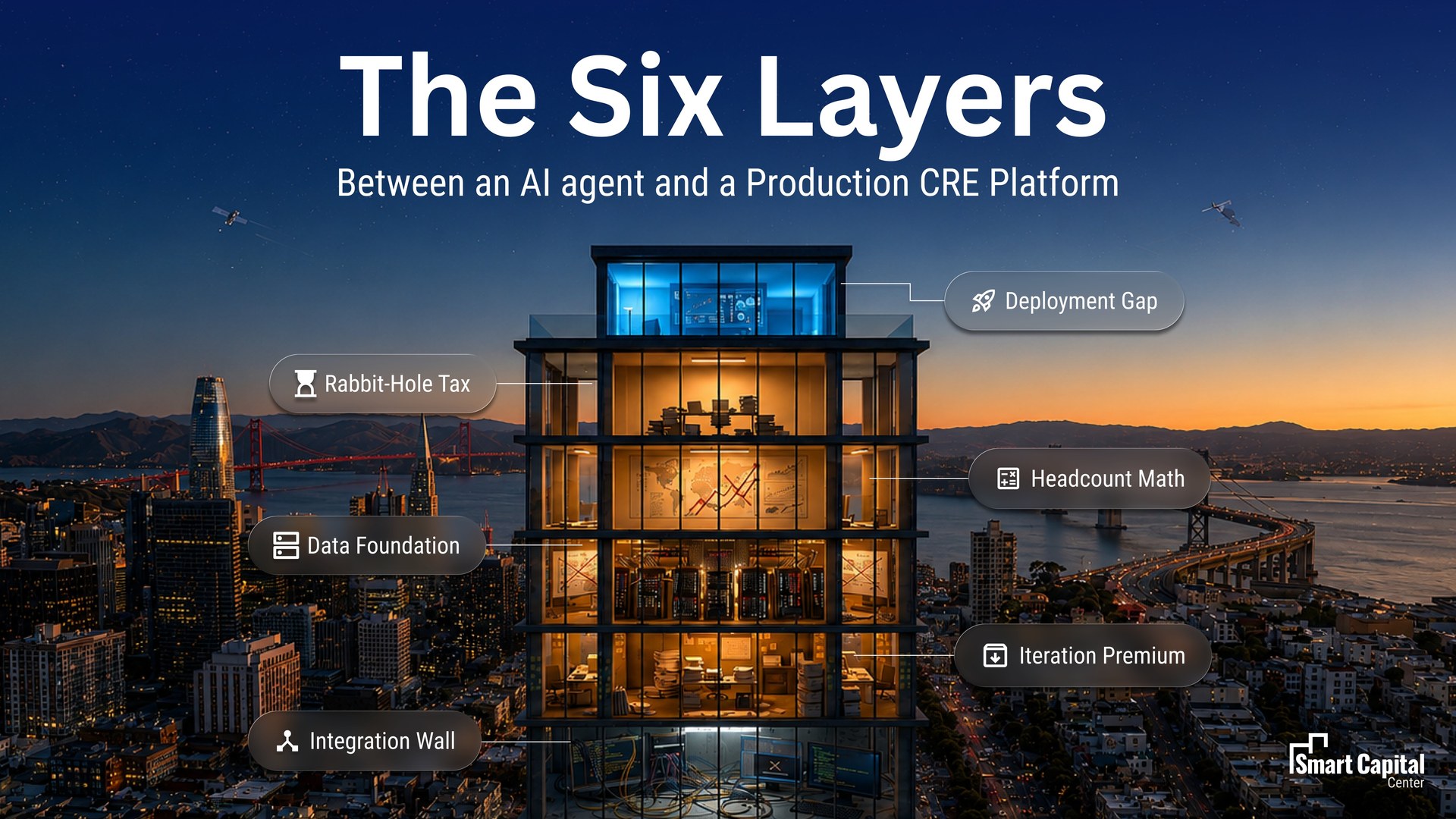
Layer 1 — The Data Foundation Problem: garbage in, garbage out is the real ceiling
In commercial real estate, the same apartment unit is labeled inconsistently across data sources — appearing as "Unit 1A" in one system, "Apt 1A" in another, and "1-A" in a third. Rent rolls export in different formats from property management software, accounting systems, and broker PDFs. Lease abstractions use different field names. Operating statements arrive scanned, redacted, or buried inside PowerPoint slides.
An AI agent trained on clean test data and deployed against this reality does not fail loudly. It fails confidently. Per McKinsey's State of AI report, 70% of top performers cite data integration as a primary obstacle to GenAI value, and 63% identify output inaccuracy as the single biggest risk in their AI deployments. In CRE, that ceiling is lower than in most other industries — Yardi's 2025 digital-transformation analysis cites a manual data entry error rate of up to 47.22% in property systems, with poor integration costing organizations as much as $15M annually.
This is the pillar that explains why an in-house pilot that worked on test data fails the first deal that matters. The data foundation is the silent killer of internal AI builds.
Layer 2 — The Integration Wall: CRE does not run on REST APIs
Commercial real estate runs on property management software exports, general ledger pulls from accounting platforms, discounted cash flow (DCF) model files from valuation tools, Excel underwriting templates, broker PDFs, and email threads six replies deep. Production-grade plugins for each of these are not features a weekend can produce. They are sustained engineering investments, refreshed every time a vendor changes its export format.
The market data underscores how systemic this is. According to Salesforce's 2025 connectivity research, 95% of technology leaders cite integration issues as a primary barrier to AI implementation. The EPRA Proptech 2024 report found 61% of CRE owners and operators still depend on outdated or disconnected systems. JLL's 2026 Global CRE Trends report names legacy infrastructure compatibility as the #1 cited blocker to AI adoption in CRE, flagged by 54% of respondents.
The integration layer is where data becomes trustworthy. It is the layer no AI agent on its own can replace — and the layer that is unglamorous, recurring, and never finished.
Layer 3 — The Iteration Premium: version 10 has seen 10,000 edge cases version 1 has not
Version 10 of a CRE platform beats version 1 not because it is better engineered, but because it has been wrong 10,000 times and learned from it. The deal where the rent roll had a unit numbering convention nobody anticipated. The lease abstract where the percentage rent clause was written into a footnote. The Debt Service Coverage Ratio (DSCR) calculation where the lender excluded a category of operating expenseeveryone else included.
This is the most defensible advantage in the build-vs-buy debate — and the hardest to feel until you have lived it. Trullion's analysis of the MIT NANDA dataset found that specialized vendors succeed on AI deployments at roughly 67%, versus 33% for internal builds. The differential is almost entirely the iteration premium baked into the vendor's prior years of deployment.
Each refinement is a year of someone else's pain. A version-1 platform inherits zero of those years.
Layer 4 — The 10x Deployment Gap: there is no end to a deployment
Production is not the finish line. It is the starting line. After version 1 ships, the appetite grows: more capabilities, more agents, more integrations, more data, more workflows automated, more connected pieces. The platform expands like a snowball — and that is when it starts breaking.
Hosting decisions made in week one hit cost ceilings by month six. Security reviews multiply with each new data source. The monitoring stack that worked for three users does not work for thirty. The team that built the agent in a weekend now needs a Site Reliability Engineer (SRE), a data engineer, a Machine Learning (ML) engineer, and a security lead — and even then, every new integration re-opens the maintenance loop.
This is why MIT NANDA's data shows enterprises (firms over $100M in revenue) report the lowest rates of pilot-to-scale conversion despite the largest budgets. Production AI is not a project. It is a permanent function of the firm.
Layer 5 — The Headcount Math Has Changed
Most in-house build estimates compare a platform license to "another software cost." That is the wrong denominator.
According to PwC's 2025 Global AI Jobs Barometer, the wage premium for AI-skilled roles reached 56% in 2025 — more than double the 25% premium in 2024. Per Signify Technology's 2026 US benchmarks, average AI engineer salary hit $206,000 in 2025 (a $50,000 increase year-over-year), with senior specialists commanding $200,000 to $312,000 in base pay alone. Loaded annual cost for a single mid-to-senior AI engineer lands between $185,000 and $265,000.
An in-house CRE platform requires at minimum a full-stack engineer, a data engineer, and fractional ML and security leads — sustained, not one-time. Compare 18 to 24 months of that loaded cost — comfortably north of $1M annually — against a platform contract. The honest comparison is not platform-vs-software. It is platform-vs-engineering-team. Most internal estimates miss the math by an order of magnitude.
Layer 6 — The Rabbit-Hole Tax: founder and principal time has the highest opportunity cost in the firm
The hardest cost to put on a profit and loss statement is the one that does not appear in any vendor invoice: principal and founder time spent learning prompt engineering, debugging a property management software export, or chasing a hallucination on a live deal.
Every hour spent on that is an hour not spent screening deals, raising capital, or running the firm. McKinsey's State of AI research finds that the firms capturing meaningful Earnings Before Interest and Taxes (EBIT) impact from GenAI are the ones that redesign workflows rather than bolt models onto legacy processes — and that workflow redesign is leadership work, not engineering work. The opportunity cost of doing both at once falls almost entirely on the people whose time the firm can least afford to spend.
Build-vs-buy stops being a technology question and becomes an operational discipline question: where is the firm's leadership leverage best spent?
3 Risks the Build Estimate Never Includes
Beyond the six layers, three documented risks drive abandoned in-house AI builds more reliably than budget overruns.
.jpg)
Eight to twelve months into the build, switching feels expensive — but real production value is still 12 to 18 months away, and competitors who bought are already on version 4. Per the Forrester / S&P Global analysiscited in industry reporting, 42% of companies scrapped most of their AI initiatives in 2025, up from 17% the year prior.
A model trained on inconsistent inputs produces outputs that look correct and are not. McKinsey identifies output inaccuracy as the single most-cited risk by 63% of organizations using GenAI, up seven percentage points year over year.
Every new system added re-opens the maintenance loop. Property management software version updates, valuation model schema changes, general ledger reorganizations — each one is a re-engineering event for an in-house build, and zero days of work for a platform with hundreds of users sharing that fix.
5 Steps To Evaluate Build vs. Buy Honestly
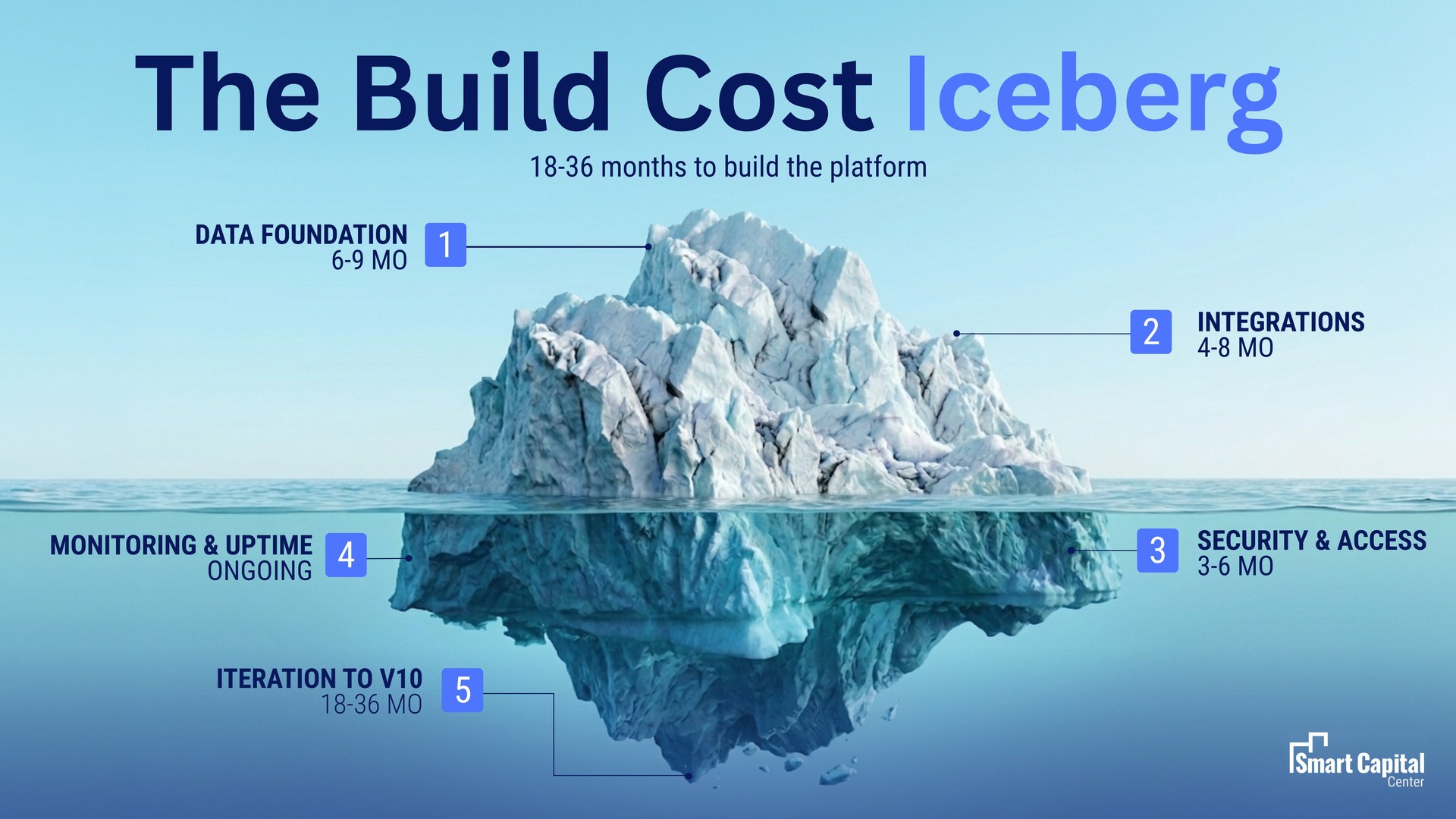
If you are evaluating an internal AI build against buying a platform, five steps will produce a more accurate comparison than any internal estimate alone. Run them before the engineering offsite, not after.
Step 1. Count the integrations you actually need. Property management software, accounting and general ledger platforms, valuation and DCF modeling tools, Excel, email, plus broker portals, lender systems, and the Multiple Listing Service (MLS) where relevant. Multiply each by 4 to 8 months of dedicated engineering. The result is the integration layer alone — before the agent, before the data foundation, before security.
Step 2. Define what production means for your firm. 99% uptime? SOC 2? LP-grade audit trail? Each requirement adds quarters of work and recurring headcount. A platform that meets these on day one is not equivalent to a build that promises them in year two.
Step 3. Score the iteration penalty honestly. Version 1 will be wrong about your weirdest 5% of deals. Are you willing to learn that on a live transaction in front of an investment committee, or would you rather inherit a platform refined across thousands of those deals already?
Step 4. Run the headcount math against an analyst hire, not against software. An in-house platform requires a sustained engineering team of at minimum three. At a $206,000 average loaded cost per AI engineer (Signify Technology, 2026), the 18-month build exceeds most platform contracts by 5 to 10x — before opportunity cost.
Step 5. Ask the platform candidate to show you their version 1. The right vendor can show you the failure modes that version 1 had and version 10 does not. If they cannot, they are not on version 10.
Smart Capital Center runs natively against the major property management, accounting, and valuation modeling platforms used in commercial real estate, plus Excel and any document or email source via application programming interface (API), operating on a data layer refined across eight years of institutional CRE deployments. The build-vs-buy math, in most cases, is no longer close — but the five steps above are how you confirm that for your specific firm.
The Reframe
The question is not whether you can build a CRE AI agent. You can — in a weekend, with the same tools your competitors have. The question is whether building the six layers around it is the highest-value use of your team's next 18 months, when the market data shows 95% of those builds will never deliver measurable impact.
You can build the agent. You cannot build the platform. Not in a weekend, not in a year, and almost never at a cost that beats running deals on one that already exists.
Frequently Asked Questions
Can I build my own AI agent for commercial real estate analysis?
Yes. Building a single-task AI agent for CRE, deal screening, memo drafting, rent-roll parsing — is achievable in days using current foundation-model tools. What takes 18 to 24 months is wiring that agent into your live data sources, achieving SOC 2-grade security, hitting 99%+ uptime, and refining outputs across thousands of real-deal edge cases. According to MIT's NANDA report, 95% of enterprise GenAI pilots fail to reach measurable business impact — almost always at one of the layers below the agent, not at the agent itself.
How long does it take to deploy an AI agent into production for a CRE firm?
Production deployment for an integrated CRE AI system typically takes 12 to 24 months. The initial agent build can be done in a weekend, but integration with property management software, accounting systems, valuation modeling tools, and email systems adds 4 to 8 months per system. Salesforce's 2025 connectivity research found 95% of technology leaders cite integration issues as the primary blocker to AI implementation — consistent with the production timelines CRE operators report.
Is it better to build or buy AI tools for commercial real estate?
For most CRE operators, buying a platform that has already crossed the deployment gap delivers significantly faster time to value than building. According to Trullion's analysis of the MIT NANDA dataset, specialized vendors achieve a ~67% success rate on AI deployments versus ~33% for internal builds. Building in-house is only justified when the firm has proprietary workflows no platform supports and the engineering capacity to maintain CRE-system integrations indefinitely.
What integrations does a CRE AI platform need to handle?
At minimum: property management software for unit, lease, and rent-roll data; accounting platforms for the general ledger and operating financials; valuation and DCF modeling tools for underwriting and asset management; Excel for legacy underwriting models; and email and document parsing for broker PDFs and lender packages. JLL's 2026 Global CRE Trends report identifies legacy infrastructure compatibility as the #1 barrier to AI adoption cited by 54% of CRE leaders, with 92% of CRE teams in active AI pilots in 2025 — up from under 5% in 2023.
What is the real cost of building a CRE AI platform in-house?
The honest cost comparison is not platform-vs-software — it is platform-vs-engineering-team. Per Signify Technology's 2026 benchmarks, the average US AI engineer salary hit $206,000 in 2025 with loaded annual cost of $185,000 to $265,000. A minimum three-person engineering team sustained over an 18-month build exceeds $1 million annually before opportunity cost — and that does not include the integrations, security, or iteration premium.
What is the biggest risk when building a CRE AI platform in-house?
The data foundation. Per McKinsey's State of AI report, 70% of top performers cite data integration as their primary obstacle and 63% identify output inaccuracy as the biggest risk in their GenAI deployments. In CRE specifically, Yardi's 2025 analysis puts the manual data entry error rate at up to 47.22% in property systems. An agent built on inconsistent data produces confidently wrong answers — and operators typically discover this on a live deal in front of an investment committee.
Stop building the platform. Start running deals on one.
See the integrations, the data foundation, and the eight years of CRE-specific refinement Smart Capital Center delivers on day one — and what your team would otherwise spend the next 18 months building from scratch. → Book a demo today