


Smart Capital News

September 2, 2026
Smart Capital News
September 2, 2026
.png)
Smart Capital Center has partnered with HNL Capital Advisors, managed by founder William Crowley, to act as the firm's AI analyst on demand. The platform now performs the underwriting, market analysis, and reporting an in-house analyst would handle for HNL's family-office clients, without the cost of a full-time hire. The partnership points to a new model for how independent commercial real estate investors get institutional-grade work done.
The hardest hire at a lean commercial real estate firm is the one you make before the deals arrive. Investor demand is climbing. In Deloitte's 2026 Commercial Real Estate Outlook, nearly 75% of owners and investors said they plan to increase their real estate investment over the next 12 to 18 months. For an independent investor or a family-office advisor, that work does not arrive evenly. It comes in waves: a 1031 exchange deadline (the tax rule that gives investors a tight window to reinvest sale proceeds), a run of acquisitions, or a week when three offering memos land at once.
A full-time analyst is built for a steady workload, not a wave. In slow months, the salary sits idle. In busy ones, one person is not enough. The firm gets stuck choosing between overhead it cannot always justify and analysis it cannot always staff.
Smart Capital Center offers a third path. The platform draws on more than 1 billion real-time data points across over 120 million properties, all from verified data sources. That is far more than any analyst could review by hand. Its agentic AI goes deeper on every deal. It analyzes more comparable sales, tests more scenarios, and surfaces patterns a person would miss, turning out more underwriting, market analysis, and reporting in less time. Experienced analysts review each output, so greater depth never comes at the cost of quality. The work is sized to the deal instead of the payroll.
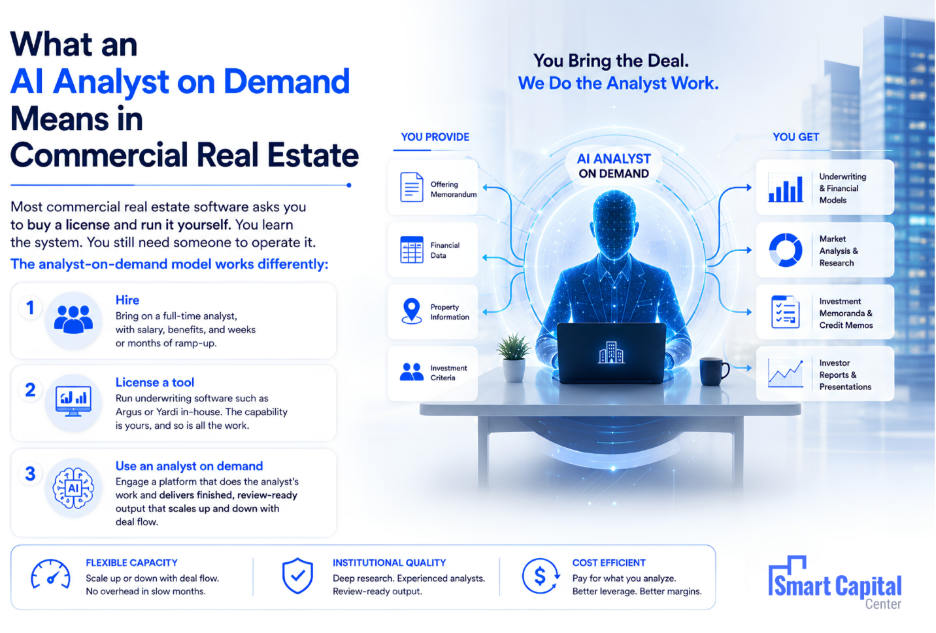
Most commercial real estate software asks you to buy a license and run it yourself. You learn the system. You still need someone to operate it. The analyst-on-demand model works differently. A firm has three ways to staff its underwriting:
The difference is not only who does the work, but how much gets done and how deep it goes. An analyst on demand processes far more verified data than a single hire ever could, then routes every output to an experienced analyst for review. You get deeper analysis on more deals, and you keep the judgment. HNL Capital Advisors took this route, and the reasons are worth looking at, because many independent firms face the same choice.
HNL Capital Advisors advises family-office clients across the United States on commercial real estate acquisitions, dispositions, and asset management. Its work spans industrial, multifamily, retail, and self-storage. The firm's value sits in its client relationships and market judgment, and its model is deliberately lean.
That model creates a familiar tension. Family-office clients expect institutional-quality analysis on every deal. Building an in-house analyst team to produce it would add fixed cost and pull the firm away from what it does best. Hiring a single analyst would leave HNL over-resourced in slow months and short-handed during a surge, such as a 1031 exchange with a tight reinvestment window.
Rather than buy underwriting software and run it themselves, HNL hired Smart Capital Center to perform the analyst role and scale that work with deal flow. The firm gets faster underwriting, more deals reviewed without adding headcount, and the institutional-grade analysis its clients expect.
“Specialist investors with deep client relationships and market insight should be able to operate with the analytical capacity of a much larger firm, on demand, sized to the deal, without compromising the lean model that serves clients well.”
— Laura Krashakova, Chief Executive Officer, Smart Capital Center

A full-time analyst is the obvious answer. For a lean firm, it is often the wrong one. According to the U.S. Bureau of Labor Statistics, the median financial and investment analyst earns $101,350 a year, and the top 10% earn more than $180,550. Add benefits, payroll taxes, software, and the time a principal spends managing the role, and the all-in cost of one hire climbs higher still.
That cost is fixed. Deal flow is not. The gap is widest for firms with uneven workloads, where an analyst is underused in quiet months and stretched thin in busy ones.
The table shows three options:
Underwriting comes down to reading financial statements well — and on that exact task, a University of Chicago study found that AI beat human analysts, predicting future earnings correctly about 60% of the time versus 53%. The researchers said the model "excels in a quantitative task that requires intuition and human-like reasoning." Smart Capital Center pairs that depth with an analyst's review, so speed never costs you human judgment.
Cost is only half the decision. Quality is the other half, and this is where lean firms have long been at a disadvantage.
Institutional-grade underwriting is the depth of analysis large investment firms produce with full analyst teams. It covers market research, lease and sales comparable reviews, pro forma cash flow modeling, and discounted cash flow analysis. For years, that level of work was hard to reach without a team to do it.
Two things change that for a lean firm.
The first is data. Good underwriting depends on comparable sales, benchmarks, and market signals that one person cannot gather by hand. Smart Capital Center is built on more than 1 billion real-time data points across over 120 million properties, ready to use.
The second is agentic AI research. Smart Capital Center's AI reads offering memos, rent rolls, and operating statements directly, then produces editable underwriting models that work in Excel, along with market analyses and investor-ready reports. Stress tests, scenarios, and side-by-side comparisons come built in. Work that used to take an analyst days now takes far less time and far less money.
A boutique firm can then review more deals, faster, at a depth that holds up with demanding clients.
The commercial real estate industry has adopted AI tools quickly, and results have lagged the enthusiasm. In Deloitte's 2026 Commercial Real Estate Outlook, a survey of more than 850 executives across North America, Europe, and Asia Pacific, only about 7% said AI has had a transformative impact on their business. Many are still experimenting or seeing mixed results.
The gap is not the technology. It is trust. The common worries are unreliable output, weak explanations, and numbers that cannot be traced. For a capital decision, a confident figure you cannot trace back to its source is worse than no figure at all.
This is why a serious analyst-on-demand model keeps a person in the loop. With Smart Capital Center, every figure traces back to the source document it came from, and an experienced analyst reviews each output before it reaches the client. The technology speeds up the work. The analyst confirms the judgment. For an advisor sitting across from a family-office principal, that combination is what makes the analysis safe to present.
Used well, these tools expand what a firm can take on. They do not replace the judgment behind the decision.
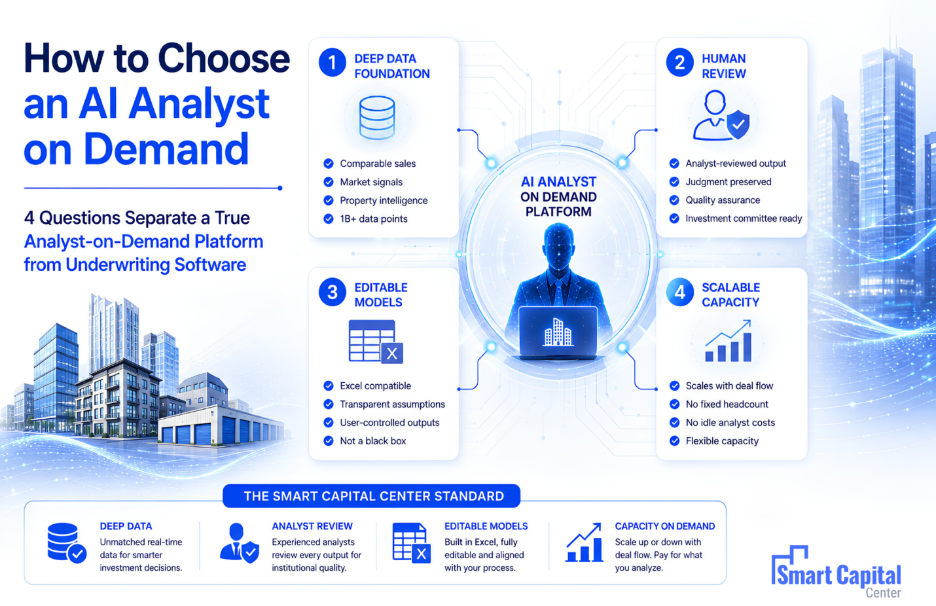
Not every platform in this category is the same. Four questions separate a real analyst-on-demand service from underwriting software with a new name.
Smart Capital Center is built around all four: deep data, analyst-reviewed output, editable models that work in Excel, and pricing that scales with your pipeline rather than your payroll.
The partnership starts with underwriting, and it is built to grow. As HNL extends Smart Capital Center beyond acquisition analysis into asset management and client reporting, the same model carries across the investment lifecycle: institutional-grade work, produced on demand, sized to the need.
That progression reflects a wider shift. Independent advisors and lean teams are adopting AI-powered platforms to operate at institutional scale, without the cost structure that used to require it.
The old question had two answers: carry the cost of an analyst, or do the work yourself. The analyst-on-demand model adds a third. For independent investors and lean advisory firms, it means institutional-grade underwriting sized to each deal, with the capacity of a much larger team and none of the fixed cost.
That matters now, with deal volume rising and margins tight. HNL Capital Advisors made the move early. For firms weighing the same decision, the model is a way to deliver institutional-quality work without institutional-scale overhead.
Review more deals without adding headcount. See how Smart Capital Center delivers institutional-grade underwriting on demand. Book a demo today.
Q: What does the HNL Capital Advisors and Smart Capital Center partnership involve?
A: HNL Capital Advisors is using Smart Capital Center as an AI-powered analyst on demand. The platform performs the underwriting, market analysis, and reporting that an in-house analyst would handle for HNL's family-office clients, scaling with the firm's deal flow. The partnership is set to expand from underwriting into asset management and client reporting.
Q: What is an AI analyst on demand in commercial real estate?
A: It is a platform that performs the underwriting, market analysis, and reporting a full-time analyst would handle, without the fixed cost of hiring one. The work scales with your deal flow. Smart Capital Center delivers this model for independent investors and advisors, pairing its AI with analyst review so the output meets institutional standards.
Q: How much does it cost to hire a commercial real estate analyst?
A: According to the U.S. Bureau of Labor Statistics, the median financial and investment analyst earns $101,350 a year, and the top 10% earn more than $180,550. Once you add benefits, bonus, payroll taxes, and software, the all-in cost of one hire climbs higher still. An analyst-on-demand platform like Smart Capital Center delivers the same work sized to deal flow, without the fixed cost.
Q: When should you use AI instead of hiring a real estate analyst?
A: When your deal flow is uneven. A full-time analyst is underused in slow months and stretched thin in busy ones. A platform like Smart Capital Center gives you institutional-grade analysis on demand, without a permanent hire, and it can process far more data in less time.
Q: What is institutional-grade underwriting?
A: It is the depth of analysis large investment firms produce with dedicated teams: market research, lease and sales comparable reviews, pro forma cash flow modeling, and discounted cash flow analysis. Smart Capital Center's AI now makes that level of rigor available to firms of any size, with editable models that work in Excel.
Q: Is AI reliable enough for commercial real estate underwriting?
A: On its own, most firms do not yet trust AI for final decisions. A reliable model keeps a person in the loop. With Smart Capital Center, the AI speeds up the analysis and an experienced analyst reviews the output before it reaches the client.
Q: How can lean commercial real estate firms compete with institutional investors?
A: By using platforms that give them the same data depth and analytical rigor without the headcount. Smart Capital Center's AI automates data extraction, financial standardization, pro forma and discounted cash flow analysis, comparable analysis, and memo creation, then routes the output to an analyst for review, so a lean firm can evaluate more deals at institutional depth.