


AI in Commercial Real Estate

July 30, 2026
AI in Commercial Real Estate
July 30, 2026

TL;DR: Loans backed by sub-investment-grade tenants default at materially higher rates than those with stronger tenant credit (Fitch Ratings), and the office CMBS special servicing rate hit 13.94% in October 2024 — a 13-year high — driven largely by tenant downsizing and departures (Trepp). Yet underwriters still spend a meaningful share of their time on fragmented manual tenant research (Deloitte 2026 CRE Outlook). Smart Capital Center's live tenant intelligence — built on always-on AI research agents, automated SWOT and sentiment analysis, and a unified tenant quality score — closes that gap by continuously monitoring every non-residential tenant across financials, news, market sentiment, and lease exposure in real time.
In commercial real estate, tenant strength is the single largest qualifier of cash flow risk — and the data sources behind that judgment have historically been static, lagging, and incomplete. Smart Capital Center now delivers live, AI-driven tenant intelligence that gives investors, lenders, and asset managers a continuous, evidence-backed view of every tenant in a portfolio — from credit quality to reputational risk — without the manual research overhead.
The platform powers underwriting and portfolio surveillance at KeyBank, JLL, RGA, Pacific Life, The RMR Group, and other institutional clients, and was named a GlobeSt Influencer in CRE Technology in 2024 and 2026.

What once took days of fragmented, manual work is now fully automated. Smart Capital Center’s platform deploys AI research agents and analysts that scour and process thousands of online data sources for every tenant. Working 24/7, they analyze industry news, financial reports, market sentiment, and external signals in real time.
These agents don’t just collect information—they digest, quantify, and qualify it, surfacing tenant-specific SWOT analyses (strengths, weaknesses, opportunities, threats) and risk insights in minutes. By synthesizing both hard data and market signals, the system delivers a continuous, always-updating stream of intelligence that was never possible manually.
This Deep Research foundation powers everything else: live news integration, sentiment tracking, exposure analysis, and automated tenant scoring. Asset managers and underwriters no longer risk missing a red flag—because the system never stops watching.
In commercial real estate, the strength of tenant cash flows defines both investment upside and downside risk. For CRE investors, tenant stability directly influences property value, exit strategy, and returns. For CRE lenders, tenant quality is a core determinant of debt service coverage, credit risk, and overall collateral performance.
Recent studies highlight the risks of relying on incomplete tenant data. Fitch Ratings has shown that loans with sub-investment grade tenant exposure are up to 7 times more likely to default. Further, more than 30% of office loans in special servicing last year were triggered by tenant downsizing or departures. Deloitte found that underwriters still spend nearly a third of their time on fragmented tenant research, increasing the risk of missed red flags. These insights underscore why CRE investors and lenders need continuous tenant intelligence, not static snapshots.
The story in one line: Traditional CRE tools tell you what a tenant signed; live tenant intelligence tells you whether they can still pay.
Most CRE platforms surface lease terms, rent obligations, and historical payment data. None of those data points capture whether a tenant's industry is contracting, whether recent layoffs threaten their lease, or whether sentiment is collapsing before financials reflect it.
Smart Capital Center addresses these gaps by combining structured financial metrics with real-time qualitative intelligence — making CRE tenant analysis actionable, comprehensive, and live.
For a deeper look at how this connects to portfolio-level risk monitoring, see our breakdown of AI-powered CRE portfolio surveillance.
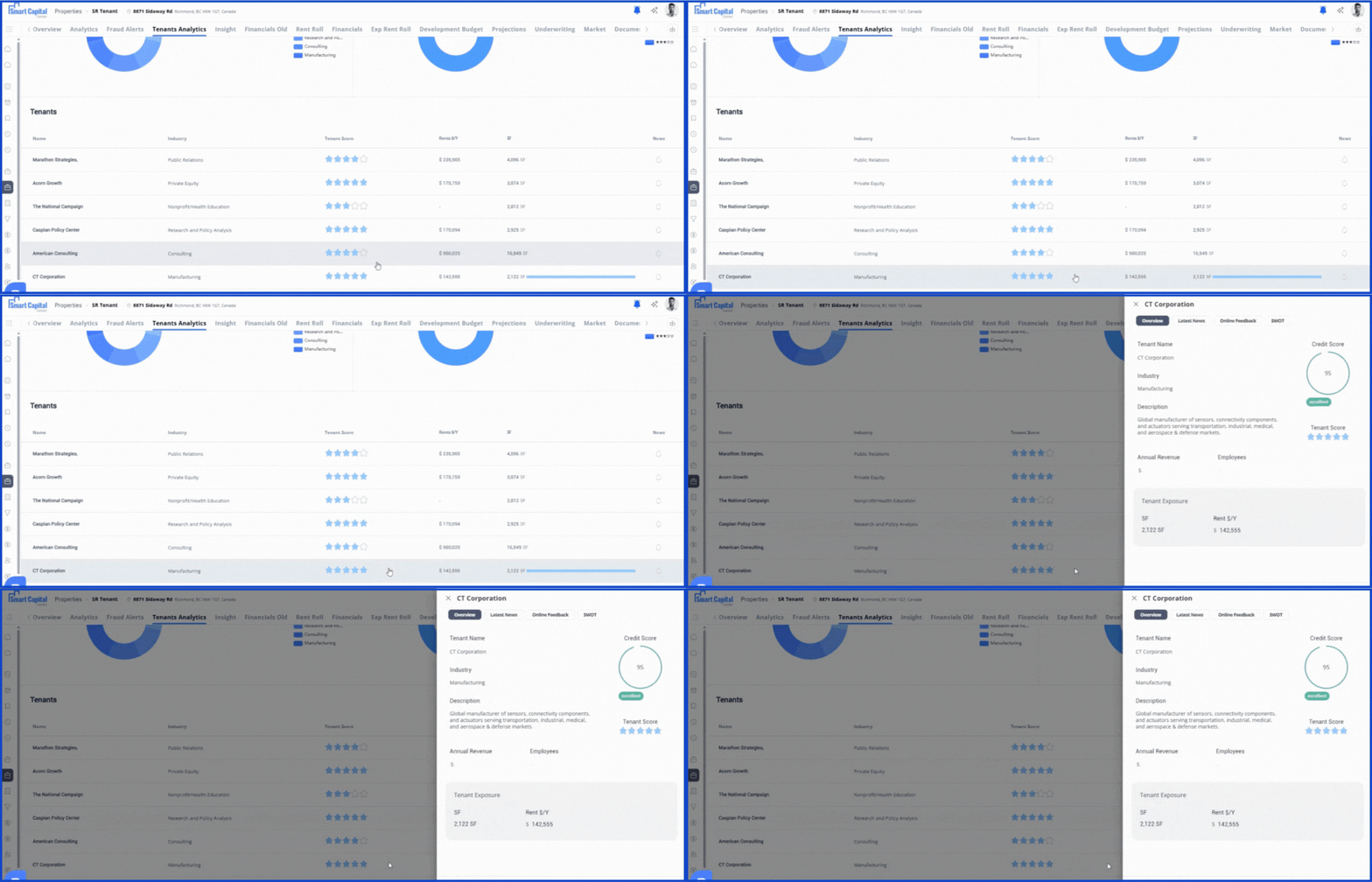
At the core of this update is a tenant overview snapshot that automatically pulls together key information on each non-residential tenant.
The profile displays:
The tenant quality score synthesizes financial data, market sentiment, industry trends, and tenant-specific news into a single comparable rating. For underwriters, this allows risk-adjusted decisions tied to real exposure. For asset managers and loan officers, it eliminates dependence on external research and creates audit-ready transparency across both qualitative and quantitative dimensions.
Revenue and employee count are not just background data—they are critical context for assessing whether tenants can sustain their lease commitments over time.
For CRE investors, this comparison highlights vulnerabilities where rent obligations may be disproportionate to tenant scale. For lenders, it supports stress-testing scenarios, such as how a tenant would fare during a downturn. The result is more robust risk assessment and greater confidence in underwriting assumptions.
Real-time CRE news and sentiment signals
One of the most powerful aspects of the tenant intelligence update is its integration with external signals:
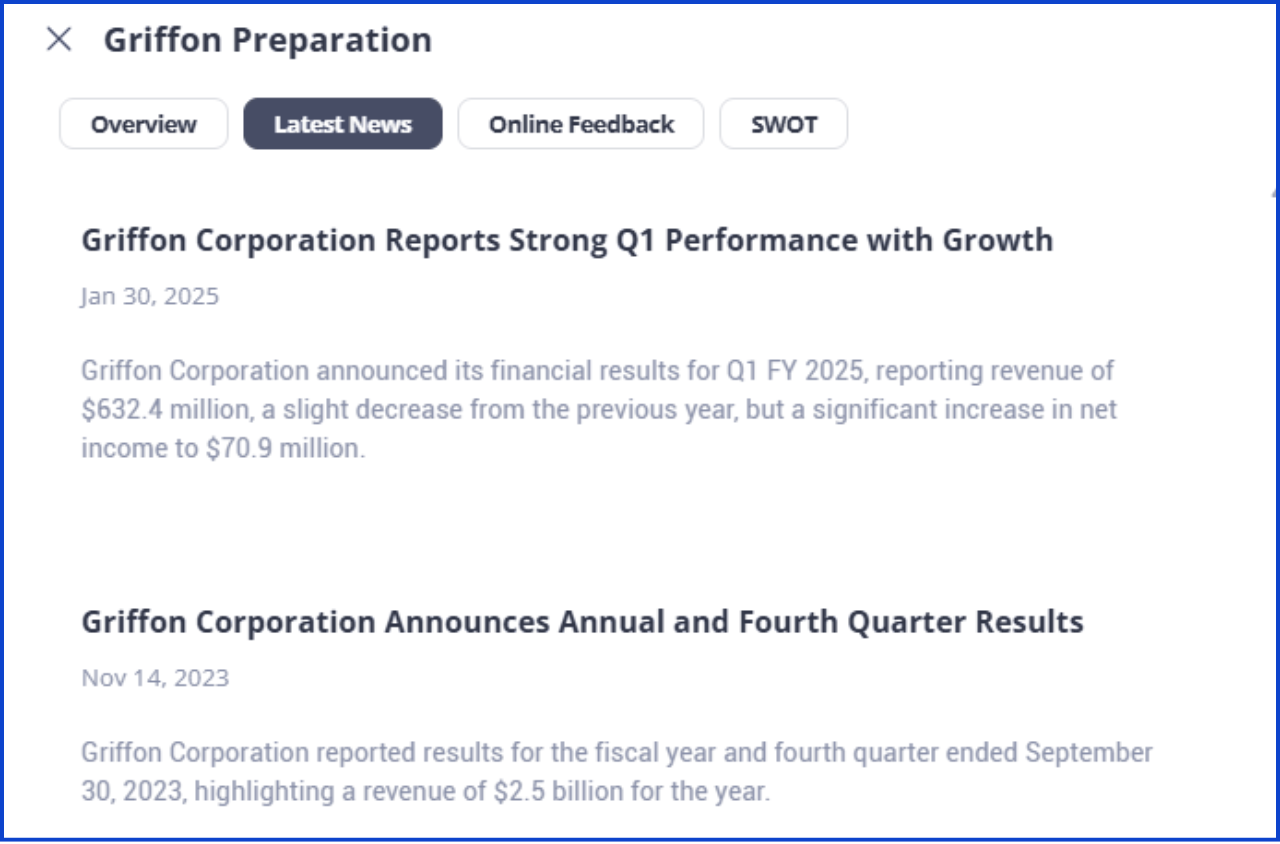
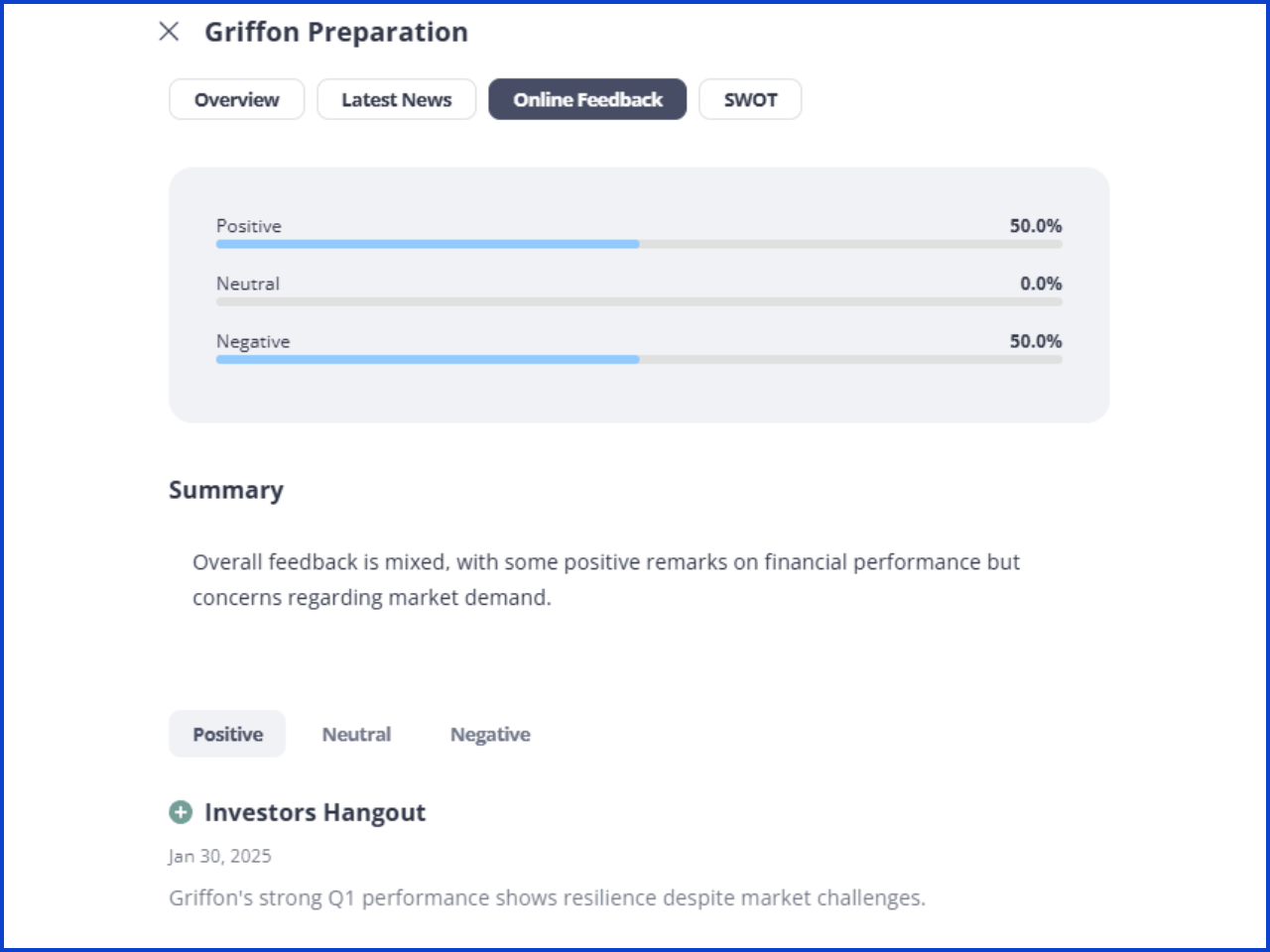
Together, these features reduce the lag between external market events and CRE decision-making. For portfolio managers and lenders, it means less dependence on manual monitoring and truly proactive asset oversight.
The story in one line: External signals — news polarity, online sentiment, employment trends — typically move before financial disclosures, giving CRE underwriters a window to act before risk shows up in DSCR.
The platform integrates two external signal layers on every tenant:
Latest news integration. A curated feed surfaces tenant-specific headlines on expansions, partnerships, layoffs, M&A, lawsuits, and material market moves. Investors and lenders see developments as they happen, not at the next reporting cycle.
Sentiment analysis. The system aggregates online feedback — reviews, employee sentiment, public perception — and classifies it as positive, neutral, or negative. Sustained sentiment decline often precedes earnings deterioration, retention loss, and ultimately rent risk.
This matters in context: the Trepp 2024 CMBS analysis shows that single large tenant departures (such as Cravath's 617,000 SF exit at Worldwide Plaza) can move an entire loan into special servicing within a single reporting cycle. Continuous monitoring of news and employment signals is the only way to catch that kind of move while there's still time to underwrite for it.
For more on how sentiment integrates with portfolio-level monitoring, see our breakdown of AI-driven asset surveillance.
The value of tenant intelligence is not limited to underwriting—it spans the full CRE investment and lending lifecycle:
In short, the feature ensures CRE professionals are never blindsided by tenant changes that could alter property performance or credit outcomes.
The story in one line: Every tenant gets a single, comparable score built from hundreds of structured and unstructured inputs — turning tenant risk from a qualitative judgment into a standardized benchmark.
Every tenant is automatically assigned an AI-generated quality score, built on Deep Research across all available data sources. Unlike traditional credit metrics or static snapshots, this score reflects a synthesis of structured and unstructured intelligence:
The system processes hundreds of inputs per tenant and refreshes them continuously. For investors, this delivers a clear prioritization framework — which tenants are stable anchors, which need closer monitoring. For lenders, it functions as an early-warning system for tenants that could erode debt service coverage or compound portfolio exposure.
"Smart Capital Center reduced our financial model prep time by 40%. What used to take three analysts a full day now takes one analyst two hours — with cleaner outputs and full traceability for our loan committee." — Ken Schroeder, KeyBank
By combining Deep Research with always-on monitoring, the scoring system replaces qualitative tenant judgment with a standardized, data-rich benchmark.
For CRE investors, this feature sharpens acquisition processes, strengthens portfolio balance, and improves value protection—while elevating the ability to identify opportunities that drive higher ROI. It empowers them to anticipate tenant risks before they erode NOI or asset value. For CRE lenders, it means stronger underwriting, more resilient debt service coverage, and better-informed loan surveillance.
By consolidating quantitative and qualitative signals into one live platform, Smart Capital Center delivers tenant intelligence as it should be: continuous, consistent, and context-rich.
Tenant dynamics are not static, and the insights guiding CRE investment and lending decisions cannot afford to be either. With AI-driven tenant analytics, Smart Capital Center equips investors, lenders, and asset managers with live intelligence that strengthens underwriting, reduces portfolio risk, and supports faster, more defensible decisions across the transaction lifecycle.
Smart Capital Center analyzes 1B+ real-time data points across 120M+ properties, has supported $500B+ in CRE transactions, and integrates with Yardi, ARGUS, SS&C Precision, and Midland Enterprise via API.
See live tenant intelligence applied to your portfolio. Book a Smart Capital Center demo today.
What is CRE tenant intelligence?CRE tenant intelligence is the continuous monitoring and scoring of commercial real estate tenants across financial performance, lease exposure, industry trends, news, and market sentiment. Unlike traditional rent roll analysis, which is static, tenant intelligence updates in real time and produces a comparable risk score for every tenant in a portfolio.
Why is tenant credit quality important for CRE underwriting?Tenant credit quality directly drives debt service coverage, NOI durability, and exit valuation. According to Fitch Ratings, CRE properties with tenant rollover or weak DSCR are expected to drive the bulk of refinancing trouble through 2025, and CMBS office loan delinquencies are forecast to reach 9.9–11% — surpassing the Global Financial Crisis peak. Tenant credit, not interest rates, is now the dominant driver of CRE distress.
How does AI improve tenant risk monitoring?AI research agents continuously scan thousands of public sources — financial filings, news, employment boards, review platforms, court records — and quantify the signals into structured risk inputs. This collapses what used to take days of manual analyst work into a continuous, always-on process, and applies the same rigor to every tenant in the portfolio rather than only the largest. The Deloitte 2026 CRE Outlook flags AI-driven underwriting and PropTech adoption as central to the 2026 recovery thesis.
What data sources does Smart Capital Center use for tenant analysis?The platform ingests public financials, employment data, news feeds, sentiment signals from review platforms, regulatory filings, court records, and tenant-specific events such as M&A, layoffs, and partnerships. These inputs are combined with the tenant's lease exposure data to generate a single, comparable tenant quality score that updates continuously.
How does live tenant intelligence reduce CRE default risk?External signals — news polarity, sentiment, employment trends — typically lead financial deterioration. The Trepp 2024 CMBS data on the office special servicing rate (which hit 13.94% in October 2024, a 13-year high) shows how quickly a single major tenant departure can move a loan into distress. Continuous tenant monitoring surfaces those leading indicators while there is still time to act — restructuring lease terms, increasing reserves, repositioning the asset, or accelerating disposition.
How does Smart Capital Center's tenant scoring work?Every non-residential tenant is automatically scored using a synthesis of financial performance, lease exposure, industry benchmarks, sentiment, reputational signals, and tenant-specific events. The score is standardized across the portfolio, refreshed continuously, and traceable to source data — so investors and lenders can prioritize attention consistently and document their reasoning for credit committees, LPs, and auditors.
How much office lease rollover is currently at risk?According to CRED iQ analysis published by Commercial Observer, more than 500 million square feet of CMBS-backed office and mixed-use leases are scheduled to expire over the next five-plus years, including 217 million square feet across 2024 and 2025 alone. With CBRE Research reporting that 49% of occupiers are taking shorter renewal terms, lease durability is structurally shrinking — making continuous tenant intelligence essential for CMBS lenders and equity owners alike.
How does Smart Capital Center help CRE investors and lenders manage tenant risk?Smart Capital Center provides continuous, AI-driven tenant intelligence integrated with broader CRE underwriting, portfolio insight, and debt management. The platform analyzes 1B+ real-time data points across 120M+ properties, supports $500B+ in CRE transactions, and integrates with Yardi, ARGUS, SS&C Precision, and Midland Enterprise via API. Book a demo to see live tenant intelligence applied to your portfolio.